A typical week for an exporter looking for overseas buyers goes like this: a few hours scanning companies on Google, an hour on LinkedIn hunting for the right person, then three emails that will never get a reply. Finding export customers with AI exists to shorten exactly this loop. But a warning up front: AI doesn’t produce a magic list. Fed with the right data, it shows you much faster which buyer to approach, when, and how.
In this guide I walk through the method that works in the field: how customs and bill of lading data is read, where AI fits into the process, and which mistakes to avoid. For exporters based in Türkiye, one of the more practical resources in this area is Bilvio’s export customer finder platform. I explain why later in the article.
Find Export Customers with AI
Analyze billions of trade data points in seconds to identify the global markets and potential customers that are right for you. Grow your export business with AI.

Search Intent: Who Is Reading This?
Someone searching this is gathering information but sits close to a decision. They’re either looking for a method or trying to choose a tool. So I keep theory short and focus on application.
If any of these questions sound familiar, you’re in the right place:
- Which country should I sell to?
- Who actually buys my product there?
- Who are my competitors selling to?
- How do I reach the buyer?
- Should I do this with my team or with a tool?
What Does AI Actually Do in Export Customer Discovery?
Let’s set expectations first. AI is useful on three layers.
1. It Cleans and Makes Sense of Data
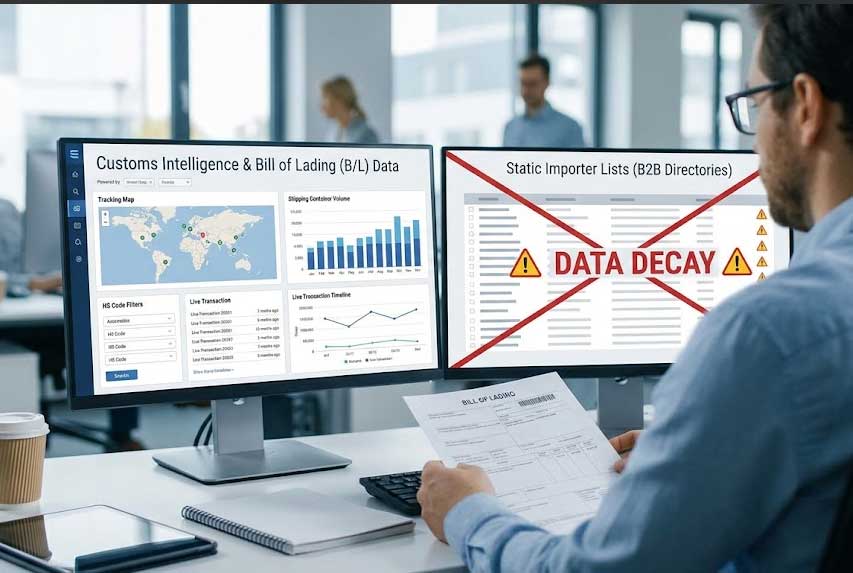
Raw customs and bill of lading records are messy. The same company can appear under five spellings, product descriptions are free text, and some fields are blank. AI cleans these records, de-duplicates companies and matches products to the correct HS code. Doing this by hand takes weeks.
2. It Scores and Ranks Buyers
A buyer simply “existing” isn’t enough. These questions matter more:
- Did they buy in the last three months?
- How often do they buy?
- Is their volume growing or shrinking?
- Did they recently switch suppliers?
Reading these signals together and ranking buyers is where AI is most efficient. A buyer who just switched suppliers needs a different approach than one who has worked with the same supplier for years.
3. It Organizes Outreach
Finding decision-maker contacts, tailoring the message to the buyer’s profile and tracking the process can also be delegated to AI. But note: automation doesn’t replace personalization, it scales it.
Where Does the Data Come From? Trade Intelligence Platforms
AI knows nothing on its own. The data it’s fed determines the quality of the result. Export customer discovery relies on three main data sources:
| Source | What it provides | Strength | Weakness |
|---|---|---|---|
| Official statistics (e.g. Trade Map, UN Comtrade) | Product import and export volumes by country | Ideal for gauging market size | Doesn’t name companies |
| Customs and bill of lading data | Buyer, supplier, product, volume, port | Shows real transactions | Coverage and lag vary by country |
| B2B directories and marketplaces | Company profiles and listings | Free or low cost | Doesn’t show buying behavior |
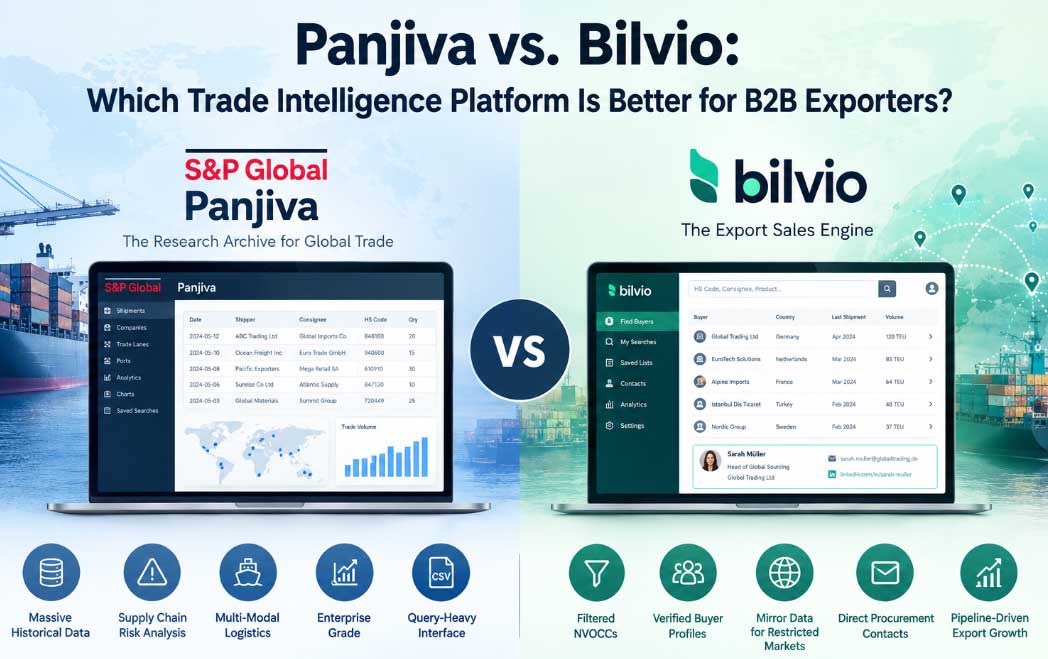
There are several platforms in this space. Hong Kong-based Big Trade Data (BTD), for example, states on its own pages that it offers import-export data covering more than 220 countries and regions, with fields such as buyer, supplier, HS code, quantity, value and port. That is the company’s own claim. Since different pages mention different country counts, confirm through a demo which countries are covered and at what level.
Bilvio, by its own description, analyzes customs and bill of lading data across 225 countries, holds over 46 million company records, and combines this with HS code search, buyer prioritization and contact discovery. These figures are also the company’s own claims.
💡 Expert note: When choosing a platform, don’t ask “how many billion records?” Ask “how many active, clean buyers appear for my HS code?” I always request the demo with the client’s own product.
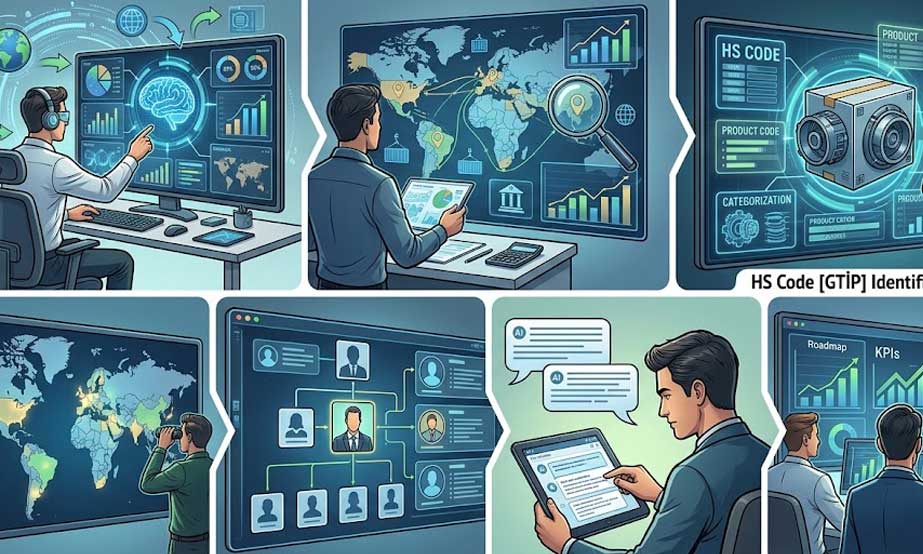
Finding Export Customers with AI: A 7-Step Method
Step 1: Pin Down Your HS Code
This step looks boring but everything rests on it. The wrong code means the wrong buyer list. Confirm your product’s 6-digit HS code and, where possible, learn the 8-12 digit breakdown by country.
Step 2: Choose the Target Market with Data
Look at the market before the buyer. Ask:
- What’s the country’s annual import volume and growth trend for your product?
- Which countries supply the market, and how are shares distributed?
- Are the number of buyers and the level of competition balanced?
This is where most exporters slip: they start with “Germany is a big market” without checking whether competition fits their scale. As Bilvio also stresses on its own page, choosing the right target market is the first and most critical step in finding customers.
Step 3: List Active Buyers
Use customs and bill of lading data to pull companies that imported your product recently. AI gives you a cleaned, de-duplicated list here. Fifty real buyers are far more valuable than 1,000 rows of noise.
Step 4: Prioritize the Buyers
Rank the list by these criteria:
- Bought in the last 3-6 months
- High purchase frequency
- Volume fits your production capacity
- Recently switched suppliers
The top 20 buyers bring far more replies than a blind list of 500. I’ve seen this repeatedly.
Step 5: Study Competing Suppliers
The same data shows who your competitors sell to, in which countries and how often. That tells you two things: which markets are saturated, and which buyers may be looking for suppliers. Instead of “stealing” a competitor’s customer, target buyers who have delivery or pricing problems with their current supplier.
Step 6: Find the Decision-Maker
Finding the company name isn’t even half the job. Who is the purchasing manager, general manager or product lead? An email to a generic “info@” address usually disappears. A system that ranks decision-maker contacts by position saves serious time here.
Step 7: Make a Personalized First Contact
If you know what the buyer imports and how often, reflect it in your message. Example:
“I see you’ve been importing product group X regularly over the past year. We manufacture it with Y capacity and hold Z certifications. May I share a sample and a price offer?”
This message works many times better than a generic “Our company produces high-quality products” email.
Real-World Tips From the Field
Working with exporters for years, I keep seeing these practices repeat:
- Start small. For the first round, 3 markets with 20 buyers each is enough. Expand based on results.
- Verify the first five buyers manually. Check their website and LinkedIn page and confirm they’re really relevant to your product.
- Track reply rates by country. The same message can get a 10% response in one country and 1% in another. If you don’t record it, you can’t learn from it.
- Mind the timing. Know the target country’s holidays and peak seasons. Response rates drop sharply around Ramadan, Christmas and Lunar New Year.
- Keep samples and certificates ready. When you catch interest, waiting three days to reply kills the opportunity.
Common Mistakes
- Buying a list and blasting emails. Low conversion and spam-flag risk.
- Blindly trusting AI. Company names in bill of lading records can be masked, missing or spelled differently. The system helps; verification is on you.
- Skipping market analysis and searching for buyers directly. Even a perfect buyer list won’t work in the wrong market.
- Ignoring cultural and legal differences. First-contact style, certification expectations and payment habits differ in every market.
- Forgetting data privacy. For commercial communication involving personal data, KVKK, the target country’s laws and GDPR in Europe apply. Check the legal framework before bulk sending.
- Treating the tool as a sales guarantee. Product quality, price, delivery and payment terms decide the deal.
Which Approach Fits Whom?
| Your situation | Suggested approach |
|---|---|
| New to exporting, don’t know the market | Scan markets with official statistics first, then try a platform on a short term |
| Looking for buyers for a specific HS code | Trade intelligence platform built on customs and bill of lading data |
| You know the buyer but can’t reach the decision-maker | A system with contact discovery and verification |
| Small team, limited time | A solution that combines data, analysis and outreach in one panel |
This is where Bilvio’s approach stands out, because it brings data discovery, market analysis, contact identification and AI-supported marketing under one roof. When the buyer list lives in one tool, the contact in another and the email software in a third, the process slows down and data gets lost. Bilvio’s export marketing system aims to unify that flow. Being Türkiye-based, with local-language support and demo sessions, is also a practical plus for small teams. As with any tool, I recommend requesting a demo with your own product and judging the result yourself.
AI vs Traditional Methods: A Quick Comparison
| Criterion | Traditional (trade fairs, directories, manual research) | AI and data-driven method |
|---|---|---|
| Time to reach a buyer | Weeks to months | Days |
| Buyer verification | Manual and slow | Fast pre-screening via trade history |
| Cost structure | Fairs, travel, agent commissions | Subscription and team time |
| Scalability | Low | High |
| Relationship quality | Strong face to face | Must be built afterward |
These two methods aren’t rivals. Meeting a data-found buyer in person at a fair strengthens the relationship enormously. The best results come from those who combine both.
❓ Frequently Asked Questions
Can AI find export customers?
Not on its own, but with the right data it helps a lot. It cleans customs and bill of lading data, ranks buyers, finds decision-makers and organizes outreach. Building the relationship and closing the sale remain with you.
What is bill of lading data?
A bill of lading is the transport document for a shipment. It generally contains the shipper, consignee, product description, quantity and port. When these records are aggregated, you can see who buys what, from whom and how often.
Is customs data the same quality in every country?
No. Some countries publish detailed records, others share limited or delayed data. Ask the platform about data coverage for your target country in advance.
Does AI-powered customer discovery make sense for SMEs?
Usually yes, because a small team’s biggest shortage is time. Still, it’s safer to start with a short-term package or a demo and measure the return first.
Is it legal to email buyers I found with AI?
It depends on the country and the person. B2B communication is accepted in many countries, but you must comply with regulations such as GDPR in Europe and KVKK in Türkiye. Get legal advice before running a bulk campaign.
Should I choose a free or a paid platform?
Free sources like Trade Map are a good start for market scanning. But company-level buyer, competitor and contact data requires paid platforms. Using both together makes the most sense.
Internal Link and External Source Suggestions
Internal link suggestions (adapt to your site):
- How to find your HS code
- Export incentives and support programs
- How to do overseas market research
- Payment methods in exporting
External source suggestions:
- ITC Trade Map (market data at trademap.org)
- Republic of Türkiye Ministry of Trade export portal
- Turkish Exporters Assembly (TİM) publications
- UN Comtrade database