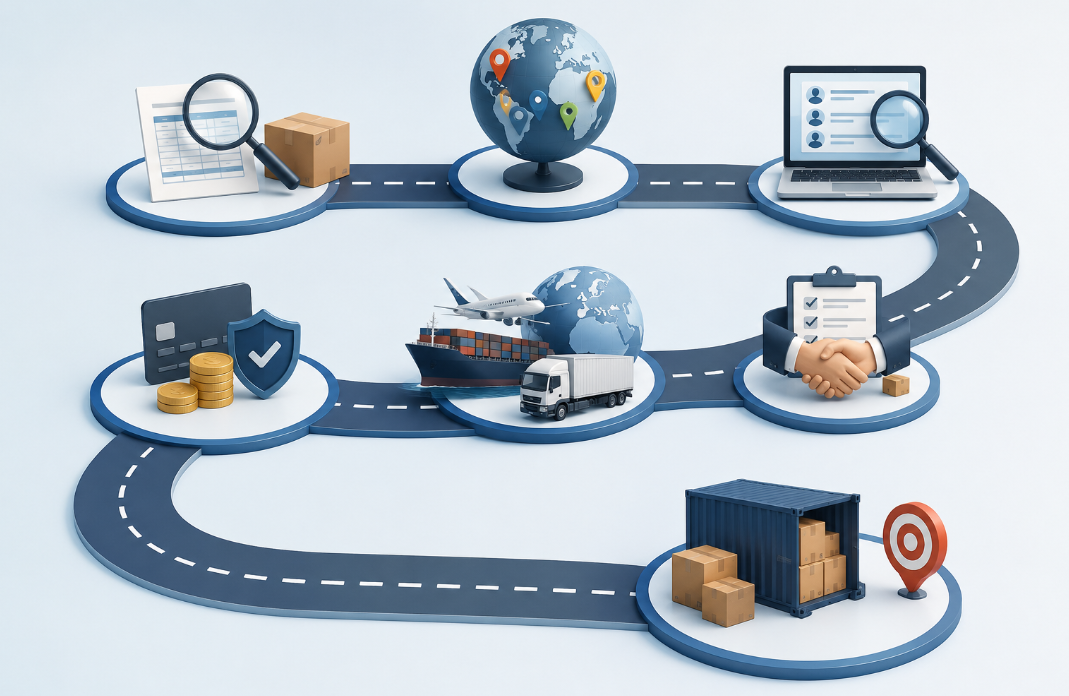
Most first-time exporters lose money not on the sale itself but on the eight weeks between deciding to export and shipping the first container. They register a company, print a catalog, book a stand at a trade fair, and only then start asking which HS code applies to their product or which countries actually buy it in volume. That sequence is backward. The exporters who make it past year one, and OECD data shows barely half of new exporters do, according to a study cited by Canada’s Office of the Chief Economist, tend to reverse the order: they confirm demand and classification before they spend a dollar on outreach. This roadmap follows that order, from product classification through the first pilot shipment, with the decisions that actually determine whether an export operation survives its first twelve months.
Export 5.0 identifies buyers and suppliers in your target market within seconds, analyzes trade trends and your target markets with up-to-date data, and enables you to reach corporate contacts of companies. It offers a powerful digital infrastructure for strategic marketing.
What Starting to Export Actually Requires Before You Ship Anything
Exporting is not a marketing decision, it is an operational one wrapped in a marketing decision. Before a company sends its first quote, it needs four things settled: a correct HS code for the product, a legal structure that permits cross-border invoicing (a tax ID or export license depending on the country), a defined target market backed by actual import data rather than a guess, and a payment mechanism the company can enforce if a buyer does not pay. Skipping any one of these does not prevent a first sale. It prevents a second one, because the first shipment usually surfaces the gap: wrong tariff classification triggers a customs hold, an unverified buyer disappears after receiving goods on open account terms, or a product turns out to need a certificate the company never applied for.
The practical starting point is smaller than most guides suggest. A company does not need a finished export department to start. It needs one correctly classified product, one market with confirmed import demand, and one payment term it can defend legally.
Step 1: Classify the Product Correctly Before Anything Else
Every cross-border shipment is taxed, restricted, or waved through based on its Harmonized System (HS) code, the six-digit international classification maintained under the World Customs Organization framework, extended to eight or ten digits by individual customs authorities. Getting this wrong is not a paperwork inconvenience. A misclassified shipment can be held at customs, reassessed at a higher duty rate, or flagged for inspection that adds a week or more to delivery, which is often enough to break a buyer relationship that was never that solid to begin with.
A Turkish exporter of frozen vegetables, for instance, needs to know whether their product falls under HS 0710 (frozen vegetables, uncooked or cooked by steaming) or HS 2005 (vegetables prepared or preserved otherwise), because the two carry different duty rates into the EU and different documentation requirements. This is not a detail to leave to a freight forwarder after the fact. Getting the classification right before quoting a buyer means the quoted price already reflects the correct landed cost, and a [HS code lookup and classification check](INTERNAL: HS code lookup tool) run against target-market tariff schedules should happen before, not after, the first buyer conversation.
Step 2: Pick a First Market With Import Data, Not Instinct
The single most common early mistake is choosing a target market based on cultural familiarity or a personal contact rather than confirmed demand. A Turkish furniture exporter defaulting to Germany because “Germans buy a lot of furniture” is directionally right but operationally useless: Germany imports furniture from dozens of countries at wildly different price points and volumes, and without knowing which HS subcategory, which price band, and which regions inside Germany are actually importing at scale, the exporter is guessing with better vocabulary than before.
Trade databases exist specifically to remove that guesswork. UN Comtrade and the ITC Trade Map publish country-level and product-level import and export values by HS code, which is enough to answer the first-order question: does this market import a meaningful volume of my product category at all, and is that volume growing or shrinking. For a sharper answer, and one that identifies specific importing companies rather than aggregate country totals, exporters increasingly run [target-market analysis and trade-map visualization](INTERNAL: target market analysis tool) against customs and bill-of-lading records, which shows not just that Germany imports frozen vegetables but which German companies received shipments in the last two quarters and at what volume.
A market decision made this way takes a day, not a trade fair trip. It also tends to produce a shortlist of two or three markets rather than one romantic favorite, which matters because the second step, finding buyers, works very differently depending on which market wins.
Step 3: Find Buyers Before You Build a Sales Deck
Once a target market is confirmed, the temptation is to build a polished catalog and start cold outreach to a generic buyer list, or to list on a marketplace and wait. Both work eventually, but both are slower and less targeted than starting from confirmed import activity. A company that has cleared customs with a shipment of your product category in the last six months has already proven three things a cold prospect has not: budget, sourcing infrastructure, and active demand. That is a fundamentally different starting point for outreach than a company that merely appears in a directory because it filled out a profile once.
This is where bill-of-lading and customs-data platforms earn their place in the process. Searching import records by HS code and destination country surfaces the companies actually receiving shipments, along with shipment frequency and, on more capable platforms, the buyer’s current supplier. An exporter targeting Egypt for ceramic tile can identify which Egyptian importers received tile shipments in the last two quarters, cross-reference volume against their own production capacity, and prioritize outreach accordingly, instead of sending the same generic email to two hundred names pulled from a trade directory. Bilvio’s approach to [buyer discovery through customs and shipment records](INTERNAL: Bilvio buyer discovery and importer identification) fits this exact step: the search starts from confirmed transactions rather than a company profile someone filled in once and never updated.
Trade fairs and marketplace listings still have a role, particularly for building a longer-term pipeline and testing product-market fit with buyers you have not yet identified through data. But as a first move, they are slower and less targeted than starting from confirmed import activity.
Step 4: Get the Paperwork and Payment Terms Right
A quote is not a sale until the payment mechanism is settled, and this is where inexperienced exporters lose the most money proportionally. The main payment terms in international trade, in order of risk to the exporter, run roughly: cash in advance, letter of credit (LC), documents against payment (D/P), documents against acceptance (D/A), and open account. A first-time exporter shipping to a first-time buyer with no trade history has no business offering open account terms, no matter how much pressure the buyer applies, because open account means the goods leave the exporter’s control before payment is confirmed.
A letter of credit, while slower and more paperwork-heavy, shifts the payment guarantee to the buyer’s bank, which is the right trade-off for a first transaction with an unproven counterparty. Once a buyer relationship has run three or four clean transactions, moving to D/P or even open account for a portion of the order is a reasonable way to compete on terms, since buyers increasingly expect flexibility from exporters they trust. The documentation stack around this (commercial invoice, packing list, certificate of origin, and product-specific certificates like phytosanitary or health certificates for food and agricultural goods) needs to be assembled before the first shipment, not improvised after a customs officer asks for it.
Step 5: Choose Incoterms and a Logistics Partner
Incoterms (International Commercial Terms, published by the International Chamber of Commerce) define who is responsible for freight, insurance, and risk at each stage of a shipment. A first-time exporter quoting FOB (Free on Board) hands responsibility to the buyer once goods clear the origin port, which limits the exporter’s logistics burden but also limits control over delivery timing and cost, something that matters if a buyer complains about a late arrival that was actually the buyer’s freight forwarder’s fault. Quoting CIF (Cost, Insurance, Freight) keeps more control with the exporter but adds complexity and working capital exposure.
For a first shipment, FOB or EXW (Ex Works) is usually the simpler choice operationally, even though CIF or DAP quotes are often more attractive to buyers who want a landed price. The right move for most first-time exporters is to quote FOB for the first transaction, learn the actual freight and insurance costs on that lane, and then decide whether to absorb that complexity into a CIF quote on the next order. Average lead time for textile exports from Turkey to Germany by road freight sits around 6 to 8 weeks factoring in production, customs clearance, and delivery, and that number shifts meaningfully by product category and mode, so confirming actual transit times with a freight forwarder before quoting a buyer delivery date avoids a broken promise on the first order.
Step 6: Run a Pilot Shipment Before You Scale
The first commercial shipment should be treated as a test, not a proof of concept for a full rollout. A pilot order, even at a smaller volume than the buyer initially requests, surfaces the real friction points: whether the HS classification holds up at the destination customs office, whether the documentation is complete, whether the buyer pays on the agreed terms without renegotiation, and whether the actual transit time matches what was quoted. Companies that skip this step and commit to a large first order based on a promising buyer conversation are the ones most likely to eat a costly mistake in year one.
Once a pilot shipment clears cleanly and payment arrives as agreed, that buyer relationship becomes a reference point, both for expanding volume with that buyer and for identifying similar buyers in the same or adjacent markets. This is also the point where ongoing [shipment and competitor monitoring](INTERNAL: competitor shipment tracking) becomes useful rather than premature: once you have live shipments moving, tracking who else is importing into that buyer’s market, and at what volume relative to your own shipments, tells you whether you are gaining share or losing it to a competitor’s more aggressive pricing.
Common Mistakes First-Time Exporters Make
The most expensive mistake is quoting a price before confirming the correct HS code and duty rate, which either erodes margin on the first order or forces an awkward renegotiation with the buyer mid-transaction. The second is offering payment terms based on buyer pressure rather than buyer history, which is how first-time exporters end up shipping goods on open account to a company they verified only by email signature. The third is treating market selection as a one-time decision made at company founding rather than a data check repeated every time the company considers a new HS code or geography. SME export participation across OECD economies remains well below that of large firms, with less than 30 percent of SMEs in the industrial sector exporting compared to nearly half of large firms, and a meaningful share of that gap comes down to smaller firms under-investing in the market research step because it feels less urgent than getting a product ready to ship.
Frequently Asked Questions
How long does it take to start exporting from scratch?
For a company with an export-ready product, the realistic timeline from decision to first shipment is 8 to 12 weeks: 2 to 3 weeks for HS classification and market selection, 2 to 4 weeks for buyer identification and first quotes, and the remainder for documentation, payment terms, and logistics booking.
Do I need an export license to start?
Requirements vary by country and product category. Most general goods do not require a special export license, but regulated categories (dual-use goods, certain agricultural products, pharmaceuticals, defense-adjacent items) do. Check your country’s customs authority and the destination market’s import restrictions before quoting.
What is the safest payment term for a first-time exporter?
A confirmed letter of credit is the standard safe choice for a first transaction with an unproven buyer, since it shifts payment risk to the buyer’s bank rather than relying on the buyer’s goodwill. Cash in advance is safer still but harder to negotiate with buyers used to more standard terms.
How do I find buyers without attending trade fairs?
Customs and bill-of-lading records show which companies are actively importing your product category in your target market, along with shipment frequency and volume. Searching by HS code and destination country against these records identifies confirmed buyers faster than cold outreach from a directory list.
Should I start with one market or several at once?
One. Running a pilot shipment, correcting classification errors, and establishing payment discipline in a single market is difficult enough without splitting attention across three. Expand to a second market only after the first produces a repeatable, profitable transaction.
What is the difference between FOB and CIF for a new exporter?
FOB hands responsibility to the buyer once goods clear the origin port, limiting the exporter’s logistics exposure. CIF keeps freight and insurance under the exporter’s control but adds cost and complexity. Most first-time exporters are better served quoting FOB until they have a clear picture of actual freight costs on a given lane.
The Practical Takeaway
Starting to export rewards sequence discipline more than ambition. Classify the product correctly, confirm demand with actual trade data rather than instinct, identify buyers who are already importing, lock in payment terms that match the buyer’s trust level, and treat the first shipment as a pilot. Companies that follow that order in their first year tend to still be exporting in their third. Companies that skip straight to the sales deck usually are not.