Many companies still research export markets using methods that have changed little over the past fifteen years. A CEO reads a country report, calls a freight forwarder to get a rough sense of demand, and rents a booth at a trade fair to test the waters. Yet the real answer to the question, “Who is buying this product, and in what quantities?” is already available in customs declarations and bills of lading from the moment a container passes through a port.
This is precisely where I recommend that exporters leverage global trade intelligence platforms such as Bilvio to build their market entry strategies on real shipment data rather than on slow, assumption-driven research. A global trade intelligence platform exists to bridge this operational gap by transforming millions of individual customs transactions into searchable, actionable intelligence that exporters can use before investing in marketing budgets or entering new markets.
In this article, we explore what these platforms actually do, the data infrastructure that powers them, the key criteria for evaluating such a platform, and the limitations that define the boundaries of this category.
Export 5.0 identifies buyers and suppliers in your target market within seconds, analyzes trade trends and your target markets with up-to-date data, and enables you to reach corporate contacts of companies. It offers a powerful digital infrastructure for strategic marketing.
What Is a Global Trade Intelligence Platform
A global trade intelligence platform is a software system that aggregates, cleans, and makes searchable the transactional records generated by international trade, primarily customs declarations and bill-of-lading filings, and layers analysis on top so a user can answer specific commercial questions without manually parsing raw shipment data. The core function is turning “somewhere out there, someone is buying what I sell” into a specific, filterable list: which companies, in which countries, importing how much, how often, and from which current suppliers.
This differs from a general trade statistics resource. A country-level trade database tells you that Germany imported $1.2 billion worth of a product category last year. A trade intelligence platform tells you which German companies received those shipments, whether that volume is growing or shrinking, and who is currently supplying them. The first is useful for a market-sizing slide. The second is useful for a sales team deciding who to call this week.
What Data Powers a Trade Intelligence Platform
The underlying data comes from a mix of sources, and the mix matters because it determines what a platform can and cannot show you. Customs declarations, filed with national customs authorities as goods cross a border, provide the most granular detail in countries where this data is disclosed publicly or made available to licensed data vendors, including product classification, value, quantity, and often the importing and exporting company names. Bill-of-lading records, filed with ocean carriers and made public in some jurisdictions (the United States being the most significant example, since US customs manifest data has been publicly available for years), add shipment-level detail like port of loading, port of discharge, and carrier.
Country coverage and data depth vary enormously depending on how much a given customs authority discloses. The ITC Trade Map, maintained by the International Trade Centre, and UN Comtrade both aggregate official country-level trade statistics and are useful for confirming whether a market imports meaningful volume of a product category at all, though neither identifies specific importing companies the way a commercial trade intelligence platform does. This is the layer where platforms differentiate: some concentrate heavily on US data because it is the most consistently available, others build broader but shallower global coverage, and the strongest platforms combine wide country coverage with a data-cleaning process that removes duplicate records and standardizes company names, since raw customs data is notoriously messy (the same importer might appear under a dozen slightly different name variants across different shipments).
Core Use Cases: What Exporters Actually Do With This Data
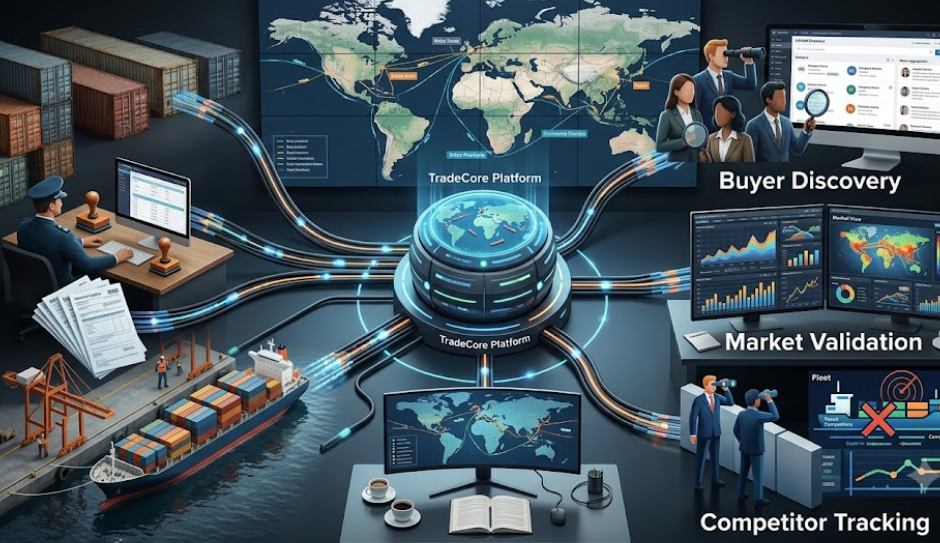
The most common use case is buyer discovery: searching by HS code and destination market to identify companies that have recently imported a given product category, then using shipment frequency and volume as a way to prioritize outreach. An exporter of frozen seafood targeting Spain, for instance, can pull up which Spanish companies cleared customs with that product category in the last two quarters rather than cold-emailing a generic directory of seafood importers with no confirmed recent activity.
A second major use case is market validation before committing budget to a new region. Rather than guessing whether a market is worth pursuing based on GDP size or cultural familiarity, an exporter can check actual import volume and trend direction for their specific HS code before deciding where to spend a marketing quarter. This is the step most companies skip, and it is the one that most reliably separates a productive market entry from a wasted trade fair trip. [Target-market analysis run against live shipment data](INTERNAL: target market and trade-map analysis tool) turns that decision from a guess into a number.
A third use case, less discussed but increasingly important as competition tightens, is competitor shipment tracking: seeing which buyers a named competitor is currently supplying, at what volume, and whether that relationship looks stable or vulnerable to a better offer. This turns trade data from a passive research tool into an active input for a sales strategy, since knowing that a competitor’s largest buyer just reduced order volume by 30 percent over two quarters is a specific, actionable signal that a general market report would never surface.
A fourth use case is import-side supplier discovery, useful for a company sourcing raw materials or components rather than only selling finished goods, and for exporters wanting to understand who currently supplies a target buyer before making an approach.
How a Trade Intelligence Platform Differs from Traditional Market Research
Traditional export market research, trade fairs, chamber of commerce reports, distributor conversations, government trade promotion agency briefings, still has real value, particularly for understanding regulatory nuance, cultural buying habits, and building in-person relationships that a data platform cannot replace. But it is slow and retrospective by nature: a trade fair happens once a year, a market report gets published on a lag, and a distributor’s read on demand reflects their own limited slice of the market.
A trade intelligence platform is continuous rather than periodic. Shipment records generate constantly, and a platform built on an updated data pipeline reflects buying activity from the last several weeks or months rather than a snapshot from whenever the last research trip happened. This matters because import buying is often cyclical: an apparel importer restocking every 8 to 10 weeks ahead of a retail season looks very different three weeks before their next order window than three weeks after it, and only continuously updated shipment data can show an exporter where a buyer sits in that cycle.
What to Look for When Evaluating a Platform
Four criteria separate a genuinely useful platform from one that looks comprehensive but underdelivers. First, country coverage weighted toward the markets you actually sell into, not just aggregate global volume. A platform boasting billions of records means little if the countries you care about have thin or outdated coverage. Second, data recency: ask directly how often shipment records refresh and how large the lag is between a customs filing and its appearance in the platform, since a three-month lag on top of an already delayed customs disclosure can mean working from data that is six months stale.
Third, whether the platform gets you to an actual contact, a name, title, and verified email or phone number, rather than stopping at the company level and leaving contact discovery as a separate manual task. This is where a meaningful share of platforms in this category fall short: they show you a company imported your product last quarter but leave you to find the purchasing manager yourself. Fourth, pricing structure. Enterprise-oriented platforms built for financial institutions and research teams often price through negotiated contracts that make little sense for an SME export team with a modest quarterly budget, while platforms built for direct SME use tend to offer transparent, tiered pricing that a company can evaluate without a sales call.
The Limits of Trade Intelligence: What It Can’t Tell You
It is worth being direct about what this category of tool does not do, because overselling it sets exporters up for disappointment. Trade data tells you who bought a product and roughly how much, but it does not tell you why a buyer chose their current supplier, what price they paid, or how satisfied they are with that relationship. It does not replace the judgment required to assess whether a company’s current supplier relationship looks displaceable or entrenched. And in markets where customs disclosure is limited or restricted (several Gulf states and parts of Sub-Saharan Africa disclose far less shipment-level detail than the US, EU, or Latin America), even the best platform will show thinner data, which is a coverage limitation worth checking before assuming global uniformity.
Trade intelligence also does not replace the fundamentals of an actual export operation: product quality, competitive pricing, reliable logistics, and the ability to service an order once it lands. A platform can put a company in front of the right buyer. It cannot make that buyer choose to place a repeat order.
How Bilvio Fits Into an Exporter’s Trade Intelligence Stack
Bilvio’s approach to this category is built specifically around the operational gap most SME exporters run into: broad platforms exist, but many are priced or structured for research teams and enterprise clients rather than a sales manager who needs a usable buyer list this week. The platform searches customs and bill-of-lading records across more than 230 countries, and pairs that shipment data with a contact layer built to identify and verify decision-makers, purchasing managers, import directors, and other buying-side contacts, at the companies it surfaces, rather than stopping at the company name.
For an exporter running through the use cases described above, Bilvio’s buyer discovery and competitor tracking tools sit at the point where market validation turns into an actual outreach list: an HS-code search returns companies with confirmed recent import activity, ranked by purchase frequency and volume, with [import-side supplier discovery](INTERNAL: import-side supplier discovery tool) available for understanding who currently supplies a target buyer before making an approach. That combination of coverage, contact depth, and workflow is what determines whether a trade intelligence subscription actually changes how a sales team spends its week, rather than becoming another dashboard nobody opens after the first month.
Frequently Asked Questions
What is the difference between trade intelligence and trade statistics?
Trade statistics are aggregate figures, total import or export value for a country and product category over a given period. Trade intelligence goes further, identifying the specific companies behind those numbers, their shipment frequency, and often their current supplier relationships, which makes it usable for direct outreach rather than only for market sizing.
Is a global trade intelligence platform worth it for a small exporting company?
For most SME exporters running active outbound sales, yes, provided the platform’s coverage matches the exporter’s target markets and pricing is structured for a smaller budget rather than an enterprise contract. The value comes from replacing cold prospecting with outreach targeted at companies with confirmed recent buying activity.
How current is the data on a typical trade intelligence platform?
This varies significantly by platform and by country, since it depends on how quickly the underlying customs authority discloses data and how often the platform refreshes its own database. Ask directly about refresh frequency before subscribing rather than assuming continuous, real-time coverage.
Can trade intelligence data show me who my competitors are selling to?
Yes, this is one of the more commercially useful applications of the category. Competitor shipment tracking shows which buyers a named competitor is currently supplying and at what approximate volume, which helps identify whether a market is already well served or has real room for a new supplier.
Does trade intelligence work the same way in every country?
No. Coverage depth depends heavily on how much shipment-level detail a country’s customs authority discloses. The US, much of the EU, and Latin America generally offer richer transactional data than several Gulf states and parts of Sub-Saharan Africa, so coverage should be checked market by market rather than assumed to be uniform globally.
What is the difference between customs data and bill-of-lading data?
Customs data comes from declarations filed with a national customs authority and typically includes tariff classification, value, and quantity. Bill-of-lading data comes from shipping documentation filed with ocean carriers and includes logistics detail like port of loading and discharge. Many trade intelligence platforms combine both to build a fuller picture of a shipment.