
A logistics risk analyst at a bank and a Turkish auto-parts exporter chasing new buyers in Poland have almost nothing in common, yet both end up comparing Panjiva and Bilvio because both platforms get filed under “trade data.” That comparison rarely holds up once you look at what each one is actually built to do. Panjiva grew out of financial-market data infrastructure and now lives inside S&P Global Market Intelligence, serving risk teams, investment analysts, and research institutions. Bilvio was built from the exporter’s side of the table: find the companies that are actively importing your product, right now, and get you in front of them. Both search customs and bill-of-lading records. What they optimize for is different, and that difference decides which one is worth an SME export team’s budget this quarter.
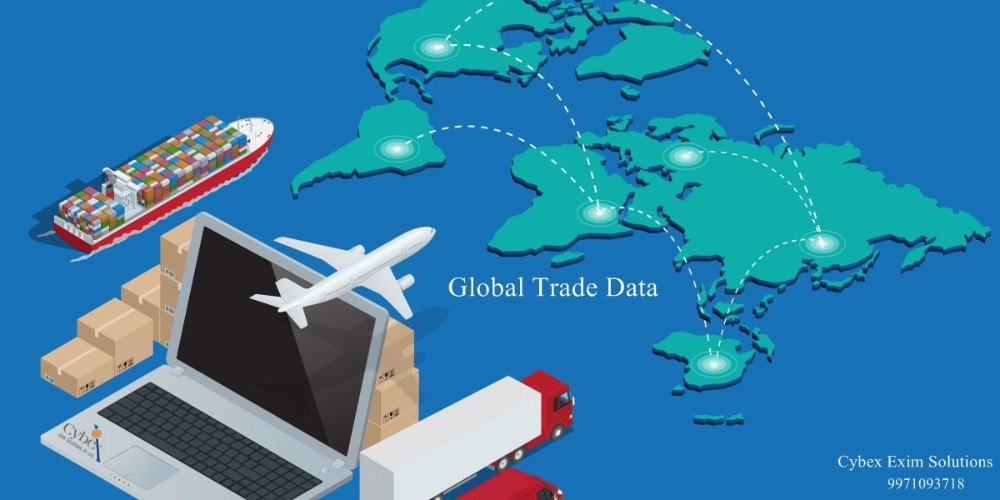
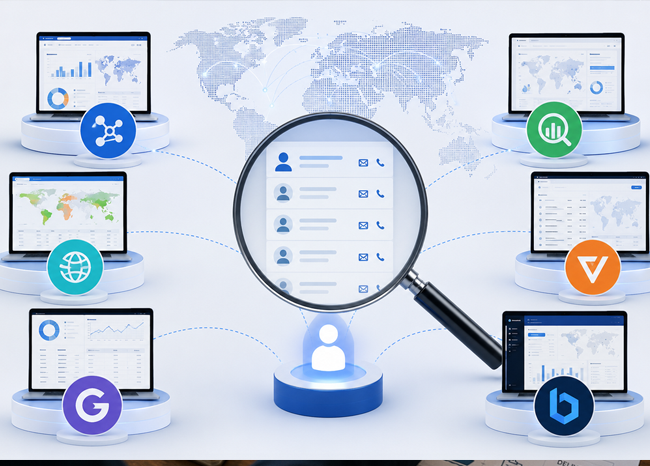
Export 5.0 identifies buyers and suppliers in your target market within seconds, analyzes trade trends and your target markets with up-to-date data, and enables you to reach corporate contacts of companies. It offers a powerful digital infrastructure for strategic marketing.
What Panjiva and Bilvio Actually Do
Panjiva is a supply chain intelligence product owned by S&P Global, built on billions of transaction-level trade records drawn from customs declarations and bill-of-lading filings. Its stated use cases run toward shipment-level detail such as commodity descriptions, consignees, and shippers, and its stated user base leans toward researchers, analysts, and institutions studying trade flows and supply chain behavior rather than active sales teams. It is a serious, well-resourced dataset with genuine depth, and it shows in the client list: financial institutions, government trade agencies, and academic researchers make up a large share of its actual usage. spglobal
Bilvio works from the same category of underlying data (customs records and bill-of-lading filings) but is built around a narrower, more operational question: which companies are importing this product, in this market, right now, and how do I reach them. Alongside buyer identification, the platform includes HS-code lookup, trade-map visualization, target-market analysis, competitor shipment tracking, and import-side supplier discovery, all oriented toward a company trying to build an active outbound pipeline rather than a company trying to model supply chain risk.
Data Coverage: Countries, Freshness, and Depth
Panjiva’s coverage is broad but uneven. Its macro-level data covers roughly 95 percent of global trade flows, while transaction-level, shipment-specific data covers about 35 percent, and that transactional depth varies significantly by country: data on Stanford’s own research access notes describe customs declaration coverage spanning around 20 countries, with date ranges that differ by market, U.S. data running from 2007 onward while China’s coverage stopped at 2018. For a risk analyst studying a specific historical trade pattern, that depth and breadth is valuable. For an exporter trying to find active buyers in Egypt or Vietnam this quarter, coverage gaps and stale country-level windows matter a lot more, because a buyer list is only useful if it reflects current activity. spglobal
Bilvio‘s coverage is built around the markets exporters actually sell into, with a design bias toward recency: the value proposition is finding companies that have imported a product category within the last several months, not building a historical research dataset. For an SME sales team, that recency bias is the more useful trade-off. A five-year-old shipment record tells you almost nothing about whether a company is still buying. A shipment from last quarter tells you they probably are.
Who Each Platform Is Actually Built For
This is where the comparison mostly resolves itself. Panjiva’s own product positioning names government and trade promotion agencies, sourcing teams, logistics providers, consultants, and research firms as its core audience, alongside exporters and importers as one line among several. Its interface, reporting depth, and integration options (APIs, bulk data delivery) are built for teams with dedicated data or research capacity, which is exactly what a large financial institution or a government trade office has and what a 15-person export sales team usually does not.
Bilvio’s design assumption is the opposite: the user is a sales manager or a business owner who needs an answer (who is buying this product in this market) without needing to build a query pipeline or hire an analyst to interpret a dataset. That is not a lesser use case, it is a different one, and it happens to be the one that matches most SME and mid-market exporters far more closely than Panjiva’s core client base does.
Buyer Discovery and Contact Access
For an exporter, the real question is not “how much data exists” but “can I turn this into a qualified outreach list this week.” Panjiva was not built around buyer contact discovery as a primary workflow. Its strength is mapping buyer-supplier relationships and tracking competitor activity within shipment records, which is useful analytically but leaves the last step, actually identifying and contacting a decision-maker at a target company, largely outside the platform’s core function.
Bilvio’s buyer discovery workflow is built to close that gap directly: search by HS code and destination market, surface companies with confirmed recent import activity, and get contact information alongside shipment pattern and import frequency. An exporter targeting [ceramic tile buyers in the Gulf region](INTERNAL: HS code and target-market analysis for ceramic exports) can go from a product code to a prioritized outreach list in one session, rather than exporting a shipment dataset and building a separate research process to identify who to actually call.
Pricing and Accessibility for SME Exporters
Panjiva’s pricing is not publicly listed in a self-serve format, and for good reason: its packaging (web platform access, API integration, bulk data delivery) is built for enterprise procurement processes, with contracts typically negotiated for institutional budgets. That is a reasonable model for a bank or a government agency. It is a poor fit for an export company trying to test a new market with a modest quarterly budget, both in cost and in the sales cycle required just to get access.
Bilvio is priced and packaged for exactly that SME and mid-market reality: Bilvio’s export intelligence platform is structured for a company that wants to start searching importer data this month, not after a procurement negotiation. That accessibility gap alone rules Panjiva out for a meaningful share of the exporters comparing the two, regardless of how the underlying data compares.
Competitor and Market Intelligence Features
Both platforms let a company see what its competitors are shipping and where. Panjiva markets this as a way to track competitor supplier relationships and product classification patterns, framed largely around risk and market-share analysis. Bilvio’s competitor shipment tracking is framed around a more direct sales question: which buyers is a named competitor currently supplying, at what volume, and is that relationship stable enough to be worth challenging with a better price or faster lead time. The underlying data category is similar. The framing, and the workflow built around it, points toward two different jobs: one toward analysis, one toward action.
Panjiva vs Bilvio: Head-to-Head Comparison
| Factor | Panjiva | Bilvio |
|---|---|---|
| Core audience | Analysts, financial institutions, government agencies, researchers | Export sales teams, SME and mid-market exporters |
| Data orientation | Broad historical and macro trade data | Recent, actionable importer activity |
| Buyer contact discovery | Not a core built-in workflow | Built-in, tied directly to HS-code search |
| Pricing model | Enterprise, negotiated, non-self-serve | SME-accessible, structured for direct sign-up |
| Competitor tracking | Risk and supply-chain framing | Sales and outreach framing |
| Ease of use for a small team | Requires analytical capacity to extract value | Built for a sales manager to use directly |
Which Platform Is Better for Exporters in 2026?
For an SME or mid-market export company trying to find and reach active buyers this quarter, Bilvio is the stronger choice, and the case is not close once pricing accessibility and workflow design are factored in alongside raw data volume. Panjiva has more institutional weight and broader macro coverage, and for a bank assessing supply chain risk across a portfolio of clients, that is exactly what matters. But an export sales manager does not need 95 percent macro coverage of global trade flows. They need a prioritized list of companies that bought their product category in the last quarter, contact information to reach them, and a workflow that does not require a data analyst to operate. That is the specific problem Bilvio was built to solve, and it is the one Panjiva was not.
Frequently Asked Questions
Is Panjiva good for small exporters?
Not particularly. Panjiva’s pricing, packaging, and interface are built for enterprise clients like financial institutions and government trade agencies, and its core workflow is oriented toward analysis rather than direct buyer outreach, which makes it a poor fit for a small export sales team working with a limited budget and no dedicated data analyst.
What kind of company owns Panjiva?
Panjiva is owned by S&P Global, part of S&P Global Market Intelligence, following an acquisition announced in February 2018. It sits alongside financial ratings, benchmarking, and analytics products aimed largely at investment and research audiences.
Does Bilvio use the same kind of data as Panjiva?
Both platforms draw on the same underlying data category, customs declarations and bill-of-lading filings, but structure and present that data differently. Bilvio emphasizes recent, actionable importer activity tied directly to buyer contact discovery, while Panjiva emphasizes broad historical and macro-level trade analysis.
Can I use Panjiva to find buyer contact information directly?
Panjiva’s core strength is shipment and supply chain relationship data rather than a built-in buyer contact discovery workflow. Extracting a usable outreach list typically requires additional research beyond what the platform surfaces natively.
Which platform has better country coverage?
Panjiva’s macro data covers a large share of global trade, but detailed transactional coverage is uneven across countries and time periods. Bilvio prioritizes coverage depth in the markets exporters actively target, with a design bias toward data recency over historical breadth.
Is Bilvio a replacement for Panjiva or a different category of tool?
For an SME exporter, Bilvio functions as a full replacement for the buyer-discovery use case Panjiva was never built to serve well. For an institutional research or risk-analysis use case, Panjiva’s broader historical dataset still has a role that Bilvio does not attempt to fill.
Panjiva and Bilvio both start from customs and shipment data, but they end up serving different jobs. Panjiva fits an analyst studying trade flows at scale. Bilvio fits an export sales team that needs a current, actionable list of buyers this quarter, without a procurement cycle or a data science background standing in the way. For most SME and mid-market exporters, that difference makes the choice straightforward.