
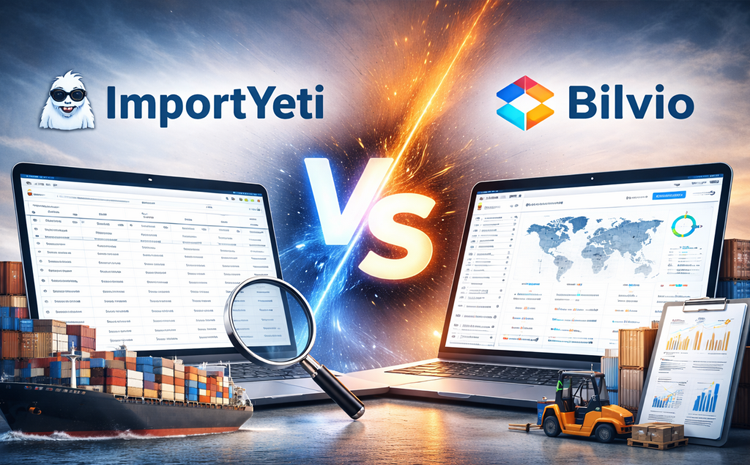
In international trade, finding the right buyers, reading target markets, and pinpointing where actual sales sit is no longer about “looking at the data.” It is about turning that data into something a sales team can act on. Two platforms come up most often when export professionals compare options: ImportYeti and Bilvio. They are not the same tool, and the difference matters when the goal is paying customers, not a clean dataset.
Find Export Customers,
Analyze Your Markets
Export 5.0 surfaces buyers and suppliers in your target market within seconds, tracks trade trends with current data, and routes you to the corporate contacts at importing companies. It is the working layer behind a serious export operation.
Export 5.0 system
What Is ImportYeti and What Does It Do?
ImportYeti is a trade-data platform built primarily on U.S. customs records. It pulls publicly available import filings together so a user can look up the shipping history of a product or a company. The records include:
Shipping records and Bill of Lading (BOL) data
Product and shipment details
Port-traffic data and logistics connections
The database holds over 70 million ocean-shipment records. A user can search those records to see how the competitive set is shipping or to surface possible suppliers. The platform is most often used for supplier discovery and competitive analysis, which is the right framing for what it is good at.
What ImportYeti is good at:
Free and freemium access keeps it usable for a junior team. Quick lookups against U.S. port records. Simple search and filtering, with a low learning curve. The ability to find suppliers and read competitive relationships at a glance, without licensing a heavier enterprise tool.
Where it falls short:
Coverage stops at U.S. customs and selected Mexican records, so most of the world’s trade flow is invisible to the platform. ImportYeti does not turn views into sales conversations either. In customer-discovery work, it shows the data, then leaves the contact research, outreach, and conversion work to you. Strategic-planning tooling is present but light, which is part of why user reviews routinely describe the platform as analytical rather than sales-operational. For an analyst the gap is fine. For an export team carrying a quota, the gap is the whole point.
What Is Bilvio, and How Does It Work?
Bilvio is a full foreign-trade-and-customer-discovery platform built for exporters. Compared to most trade-data sources, Bilvio is structured differently from the ground up:
Current, processed import and export data from across global markets, refreshed on a steady cadence.
Goes past raw display. Bilvio surfaces the data already shaped into analysis and insight, not just rows of records the user has to interpret manually.
Built around customer acquisition: importing companies are listed with their buying frequency, trends, and the buyer profiles most likely to convert, in a form a sales team can use the same day.
Trade intelligence at the level a working operation needs: market analysis, competitor tracking, and HS-code product movement, all queryable from one place.
Market, customer, and trend views consolidated onto one dashboard, so the team is not switching between three tools to answer one question.
Because of how the platform is built, an exporter spends time on the customer opportunities that can actually convert, not on cleaning data. That difference compounds over a quarter.
Where Bilvio is strong:
Importing companies ranked by purchasing behavior. The “most-likely-to-buy” buyer profile pulled from real commercial data, not surveys. Demand surfaced through HS-code-based market trends. A working interface built for sales teams, not analysts. Data presented as commercial insight, with a results-oriented angle, not just a list dump that someone else has to triage.
Comparative Review: ImportYeti vs. Bilvio
| Criterion | ImportYeti | Bilvio |
|---|---|---|
| Data Coverage | U.S.-focused ocean-shipment data | Global imports and exports, queryable by HS code |
| Customer-Acquisition Focus | Light. Provides data, leaves conversion work to the user | High. Direct paths to potential customers |
| Strategic Market Analysis | Limited reporting and analytics | HS-code-level analysis, market trends, and competitor view |
| Sales-Conversion Support | None | Built in. Sales opportunities are prioritized. |
| Intended Use | Analysis and supplier discovery | Analysis, lead generation, and market strategy |
Which One Actually Brings In Export Customers?
After working with both platforms in real export operations, the read is clear:
ImportYeti is a viewing tool. It is useful for understanding suppliers and watching how U.S.-bound trade flows. For finding paying customers across global markets, it is not the right tool for the job.
Bilvio goes past data display. It turns data into commercial insight.
The platform answers the questions a sales team actually has on a Monday morning:
Which companies are importing this product right now?
How often are they buying, and at what volume?
What does their buying pattern look like over the last few quarters?
Who is the competitive set, and where are they shipping?
How does the target market look at the HS-code level?
Bilvio works the data into customer opportunities you can act on this week. That is the gap that decides whether trade data sits in a tab as background reading or moves an export operation from analysis to action, which in this market is also the gap between hitting a quarterly target and missing it.