

When it comes to finding suppliers in China, most entrepreneurs make the same mistake. They search Alibaba, collect a few quotes, pay the lowest one, and wait.
Some receive goods that do not match the sample. Others pay and never hear back. A third group makes it through the sample stage but watches quality collapse in mass production. The common cause in all three cases is the same: the supplier was never properly vetted.
China is a massive ecosystem responsible for a large share of global manufacturing. Inside it sit deeply established factories alongside dozens of intermediaries and fake profiles imitating those factories. Picking the right company and verifying it is the foundation of a working supply chain.
This guide walks through how to find suppliers in China the right way, step by step.
Do your research before working with a supplier in China
To avoid unpleasant surprises in your business dealings with China, check your supplier in China and get access to dozens of details about that company in seconds
COMPANY RESEARCH SYSTEM
Why Finding Suppliers in China Is Both Easy and Hard
Search Alibaba for “wholesale supplier” and you will get tens of thousands of results. That is the easy part. The hard part is identifying, among those results, a company that is actually reliable, has real production capacity, and keeps its commitments.
To be direct: a large share of the companies operating in China are not factories at all. They are trading companies, in other words intermediaries. There is nothing wrong with that, but if you are expecting factory-direct prices, working with an intermediary will mislead you. And not every intermediary is trustworthy either.
So how do you find the right company in this sea of options? You start by looking in the right place.
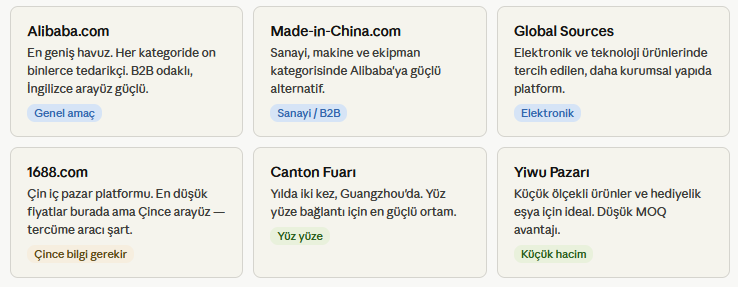
What to Watch for When Choosing a Platform
- Pick the platform best suited to your product category before anything else
- Do not blindly trust platform badges (Gold Supplier, Verified)
- Check the profile age. Profiles under one or two years old need extra scrutiny
- Check whether product photos are real or stock images
- Response time and communication quality are good proxies for how professional the supplier is
Once You Find a Supplier, the Real Work Starts: Verification
Finding a supplier in China is not difficult. Finding the right one is. The only path through is a systematic verification process.
Step 1: Check the Company Registration
Every legally registered company in China appears in the national business registry. The registry exposes critical information: incorporation date, registered capital, legal representative, shareholders, operational status.
Working through that registry in Chinese is genuinely difficult for most Turkish importers because of the language barrier. This is exactly where Bilvio’s Chinese company research system earns its place.
Enter the supplier name or registration number on Bilvio and you get the registry data instantly. The tool is especially useful for importers who do not read Chinese or do not want to lose time piecing things together manually.
Step 2: Request a Video Call and Factory Tour
Once registration checks out, take one more step. Ask for a live video call. A reputable supplier will not refuse. During the call, watch for the following:
- Is there an active production environment in the background?
- Does the person on the other end actually work at that company?
- Does the physical space match the capacity they claim?
- How is the quality of their English communication?
Step 3: Check References
Ask the supplier for contact details of two or three customers who have bought similar products. Then actually call those references. Most buyers skip this step because it feels like a “waste of time.” A 10-minute phone call can prevent a problem that drags on for months.
Step 4: Verify Certificates
If the supplier hands over a CE, ISO, FDA, or similar certificate, verify it through the issuing authority. Counterfeit certificates are a known problem in trade with China. Seeing the document is not enough. You need to confirm it is genuine.
Trading Company or Factory? The Difference Matters
| Criterion | Factory (Manufacturer) | Intermediary (Trading Company) |
|---|---|---|
| Price | Lower | Margin added on top |
| MOQ flexibility | Usually higher MOQ | Smaller quantities possible |
| Customization | Full control | Limited |
| Communication speed | Direct, fast | Slowed by the middle layer |
| Best fit | Medium-to-large volume orders | Small orders, broad product mix |
| Company registration | Production license required | Business license, different categories |
Working with an intermediary is not always a bad call. If you are buying small volumes or pulling from many product categories, a trading company can be the right choice. Just go in with eyes open. Do not expect factory prices from an intermediary without realizing what you are doing.
Questions to Ask in the First Supplier Meeting
- Have you previously exported this product to Turkey or Europe?
- What is your monthly production capacity?
- What is the minimum order quantity (MOQ)?
- Can you customize the product (color, logo, packaging)?
- What is your production lead time and delivery schedule?
- What certifications do you hold, and can you provide proof?
- What are your payment terms?
Do not hesitate to ask. A professional supplier is happy to answer. If they get evasive or push some answers to “later,” that itself is an answer.
The Sample Stage: See It Before You Pay
After verifying the supplier, get a sample. This is the most critical step before placing a mass-production order. A few key points:
- Do not accept a generic “showroom sample.” Ask for a sample pulled straight from the production line
- Have the sample tested by an independent lab, not in your own facility, especially if you are selling into the EU
- Once the sample is approved, document every specification in writing
- You can request a second “pre-production sample” before mass production begins
The Contract: If It Is Not in Writing, It Does Not Exist
Verbal agreements do not hold up in business with China. Put everything in writing. The contract should cover:
- Product specifications (technical details, materials, dimensions, color)
- Delivery date and penalties for delay
- Payment terms and due dates
- Quality standards and acceptance criteria
- Return and refund policy for defective product
- Dispute resolution mechanism
If possible, draft the contract in both English and Chinese. A contract governed by Chinese law is far stronger if a dispute ends up in court.
Common Mistakes to Avoid
- Picking a supplier off platform ads with “this looks good”
- Paying without checking the company’s registration status
- Accepting payment via Western Union or cryptocurrency
- Going for a very high volume on the first order
- Communicating with the supplier only by email. Use WeChat
- Skipping or shortening the sampling stage
- Failing to verify that certificates are genuine