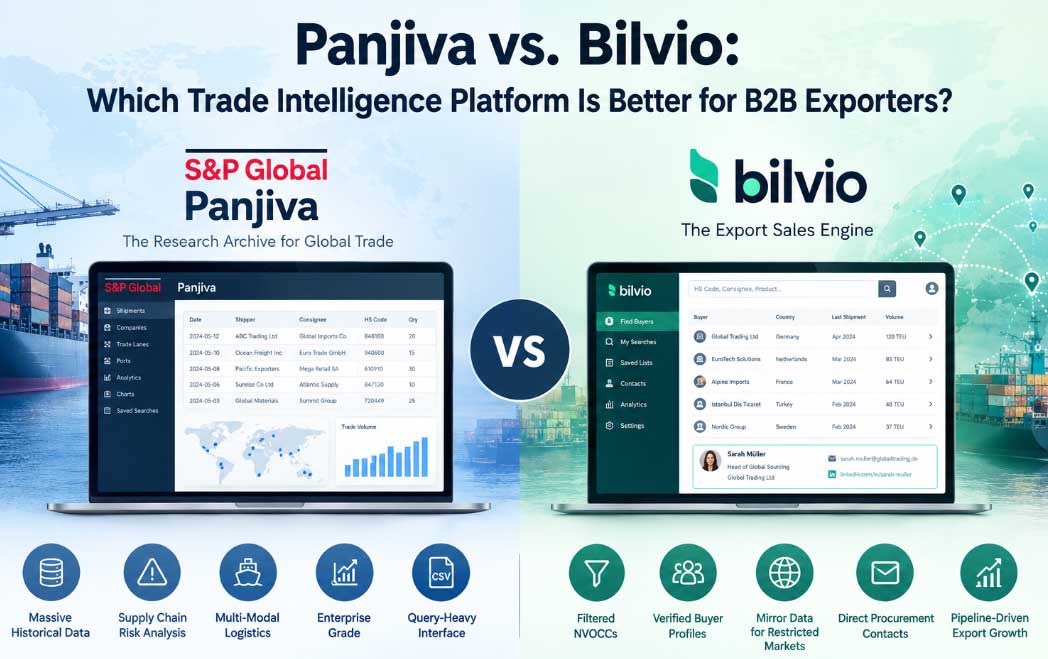
For active B2B export sales teams and mid-market manufacturers, Bilvio offers a more practical, pipeline-driven solution than S&P Global Panjiva. While Panjiva remains a powerful, enterprise-grade data warehouse for macro supply chain risk, financial auditing, and multi-modal logistics research, its high pricing threshold ($8,000–$10,000+ per year) and query-heavy architecture create operational friction for sales development representatives (SDRs).
Panjiva is engineered primarily for corporate procurement officers, risk analysts, and macroeconomic researchers who require broad historical datasets across ocean, rail, and trucking lanes. Bilvio, by contrast, is built directly around the outbound export workflow: isolating active commercial consignees from freight forwarders, reconstructing buyer networks in privacy-restricted markets (such as the EU and Turkey) via partner-country mirror data, and enriching verified customs transactions with direct procurement contact details.
If your objective is academic, financial, or global supply chain vulnerability analysis at enterprise scale, Panjiva delivers immense research depth. If your mandate is identifying active overseas buyers, auditing competitor shipment cadences, and arming international sales teams with verified B2B leads at an accessible investment level, Bilvio provides superior commercial return on investment.
Find Export Customers with AI
Analyze billions of trade data points in seconds to identify the global markets and potential customers that are right for you. Grow your export business with AI.

Architectural DNA: Research Warehouse vs. Outbound Pipeline
Understanding the difference between S&P Global Panjiva and Bilvio requires looking at the core users each platform was designed to serve. Trade intelligence is not a one-size-fits-all commodity; how data is indexed, surfaced, and connected determines whether it functions as a research archive or a practical sales engine.
Platform Workflow Architecture
Panjiva — Research Archive Model
Raw Manifest Records → Complex Boolean Query → Massive CSV Export → Manual Cleaning → External Contact Scrapers
Bilvio — Active Pipeline Model
HS Code / Consignee → Auto-Filtered NVOCCs → Verified Buyer Profiles → Mirror Data Mapping → Direct Procurement Contacts
S&P Global Panjiva: The Macro Enterprise Archive
Panjiva was acquired by S&P Global in 2018 and integrated into its S&P Capital IQ and Market Intelligence ecosystems. This institutional backing gives Panjiva immense data scale. It indexes billions of shipment records across maritime, Mexican and Canadian border trucking, and US domestic intermodal rail.
However, this corporate lineage means Panjiva’s user interface prioritizes broad-scope compliance, ESG tracking, vendor risk mitigation, and investment thesis validation. A sales manager trying to identify which mid-sized distributors in Central America are actively buying industrial fasteners must navigate dense, multi-column database tables designed for risk compliance officers rather than quota-carrying sales reps.
Bilvio: The Operational Export Sales Engine
Bilvio was developed to solve the day-to-day execution bottlenecks faced by manufacturers, export managers, and trading companies. Rather than serving as a passive historical library, it focuses on the tactical layers of modern trade growth:
Eliminating logistics noise (clearing agents and non-vessel operating common carriers).
Verifying the actual procurement cadence of prospective buyers.
Providing an accessible transition away from speculative directory lists toward verified transactional demand.
Exporters seeking practical growth methodologies can explore our comprehensive strategy on leveraging international buyer discovery platforms to structure their proactive sales outreach.
Head-to-Head Feature Comparison
To evaluate how each system performs in commercial operation, we analyze the two platforms across the critical functional requirements of an export department.
Contact Enrichment: The Missing Link in Trade Data
The most critical operational bottleneck in traditional trade intelligence platforms is the disconnect between shipment verification and executive outreach.
Discovering that an overseas importer cleared 15 ocean containers of your exact product last month is commercially valuable. However, that intelligence stalls if your sales development team cannot locate the individual responsible for awarding the contract.
Historically, platforms like Panjiva provide legal entity records extracted directly from shipping manifests. These manifests list corporate entity names and legal addresses, but rarely contain actionable contact details. When contact fields are populated, they typically consist of generic administrative addresses (info@, import@, or reception@).
The Outbound Prospecting Conversion Funnel
Legacy Manifest Search — Panjiva Workflow
Raw Shipment Record → Legal Entity Name → Manual LinkedIn / Web Search → Third-Party Scraping Tool → Unverified Inbox (High Bounce Risk)
Enriched Customs Intelligence — Bilvio Workflow
Verified B/L Manifest → Direct Decision-Maker Profile: VP Global Sourcing → Deliverable Corporate Email + Verified LinkedIn
As detailed in our investigation of B2B websites and export tool directories, unsegmented directory inquiries generate response rates below 0.5% because they fail to bypass enterprise gatekeepers.
Bilvio bridges this structural gap by natively integrating transactional customs intelligence with verified B2B decision-maker enrichment. When an exporter identifies an active buyer through maritime manifests, Bilvio isolates the procurement hierarchy:
Head of Global Sourcing
VP of Supply Chain & Logistics
Category Procurement Director
Managing Director / Managing Partner
Equipping sales teams with direct email addresses and verified executive profiles tied to documented shipment histories transforms outbound business development from cold solicitation into informed commercial consultation.
Navigating Opaque Customs Jurisdictions: The Mirror Data Battleground
A fundamental challenge in global trade intelligence is the disparity between transparent and privacy-restricted customs jurisdictions.
Transparent Jurisdictions: The United States, India, and extensive parts of Latin America (such as Mexico, Colombia, and Peru) publish detailed Bill of Lading manifests containing raw consignee and shipper details under statutory disclosure frameworks (e.g., US CBP Automated Commercial Environment regulations).
Privacy-Restricted Jurisdictions: The European Union, the United Kingdom, and Turkey maintain strict statutory confidentiality over domestic import manifests under corporate privacy mandates and customs codes.
In privacy-restricted markets, an enterprise searching for inbound German or French consignees on standard databases encounters significant information gaps.
Mirror Data Logic: Solving EU Privacy
Transparent Export Origin (e.g., Vietnam, India, USA)
Outbound Shipping Manifest:
Shipper: Asian Factory
Destination: Hamburg Port
HS Code: 8481.80 (Industrial Valves)
Privacy-Restricted Destination (e.g., Germany, France, Turkey)
Port of Discharge / Inbound Delivery:
Consignee: European Buyer X
Legally masked on local EU import data, but fully disclosed on origin filings.
To resolve this limitation without relying on obsolete directory spreadsheets, Bilvio utilizes Partner-Country Mirror Trade Data Reconstruction. While European customs authorities do not publish the identities of firms clearing containers in Rotterdam or Hamburg, exporting countries with transparent legal frameworks publish outbound declarations.
By systematically aggregating, cleaning, and cross-referencing outbound shipments from major manufacturing origins (such as India, the US, or Vietnam) that list EU destinations, Bilvio reconstructs the supply chains of European and Turkish buyers. Trade teams can view:
The exact identity of the European corporate consignee.
The incumbent overseas suppliers fulfilling their orders.
Historical shipment cadences, loading ports, and volume stability.
While Panjiva provides immense depth within open jurisdictions and macro-level aggregate trade statistics, Bilvio’s algorithmic focus on mirror data gives exporters an operational advantage when targeting privacy-restricted European trade lanes. For teams evaluating how to structure these insights, our breakdown of the four layers of foreign trade intelligence explains how macro flows and operational shipment data combine to uncover shielded buyers.
Operational Usability: The Learning Curve for Sales Teams
Software utility is dictated by user adoption. An analytics platform that requires weeks of training or complex technical query construction creates significant drag on outbound sales teams.
Panjiva functions as a comprehensive data mine. It yields immense intelligence if you have dedicated data operations specialists who can clean raw tables, parse carrier descriptions, and cross-reference records against corporate registries.
Bilvio functions as an active prospecting workspace. Its interface handles intermediary filtering and entity resolution automatically, allowing an export manager to enter an HS code, filter by minimum container volume, and review qualified, active commercial buyers within minutes.
Pricing Models & Return on Investment (ROI)
The financial threshold required to access trade intelligence fundamentally alters its return on investment for small and mid-sized businesses.
Panjiva’s Enterprise Pricing Structure
Panjiva does not offer public self-service subscription plans. Access is sold through annual enterprise contracts negotiated via S&P Global sales representatives. Baseline entry packages typically range from $8,000 to $12,000+ per year for limited seats, with enterprise-wide licenses and API feeds escalating significantly higher. For Fortune 500 supply chain departments and capital funds managing billion-dollar risks, this is standard enterprise software expenditure. For a mid-market industrial manufacturer exporting 30 to 100 containers annually, it represents an immense fixed cost that demands a high threshold of closed deals simply to achieve break-even.
Bilvio’s Scalable Subscription Model
Bilvio structures its investment tiers around the operational realities of growing exporters and mid-sized commercial enterprises. Rather than enforcing multi-seat enterprise contracts, Bilvio provides modular, accessible subscription plans. This allows companies to deploy live customs data without committing extensive capital budgets.
For organizations auditing digital infrastructure, our comprehensive B2B export buyer platform comparison provides a broader framework for evaluating technology costs against direct sales outcomes.
Strategic Scorecard: Which Platform Fits Your Business?
Choosing between Panjiva and Bilvio depends on your organizational objectives, available analytical bandwidth, and sales execution model.
Frequently Asked Questions
What is the primary difference between Panjiva and Bilvio?
The primary difference lies in workflow alignment. S&P Global Panjiva is an enterprise research database engineered for supply chain risk auditing, macro research, and multi-modal logistics tracking. Bilvio is an active B2B export intelligence platform designed to help commercial sales teams identify verified international buyers, scrub logistics intermediaries, navigate opaque markets via mirror data, and connect directly with procurement decision-makers.
How much does S&P Global Panjiva cost compared to Bilvio?
Panjiva requires annual enterprise contracts that typically start between $8,000 and $10,000+ per year for basic multi-seat access, with enterprise licenses climbing higher. Bilvio provides flexible, accessible subscription plans designed to fit mid-market manufacturers, SME exporters, and growing sales teams without prohibitive multi-seat commitments.
Does Panjiva provide direct contact information for buyers?
Panjiva provides comprehensive corporate entity data, but direct decision-maker contact details are limited. Contact fields are frequently empty or populated with generic administrative mailboxes (info@). Bilvio addresses this by integrating B2B contact verification directly into its platform, matching active Bill of Lading records with verified email addresses and professional profiles for sourcing and procurement managers.
How do Bilvio and Panjiva handle data in European markets where customs records are private?
Customs authorities across the EU, the UK, and Turkey do not publish inbound manifest records due to statutory confidentiality laws. Panjiva focuses largely on jurisdictions with open manifest laws. Bilvio resolves European blind spots through partner-country mirror data reconstruction—analyzing outbound shipments from transparent exporting nations (such as the US, India, or Vietnam) to identify European consignees receiving the cargo.
Can both platforms automatically filter out freight forwarders and logistics companies?
Panjiva indexes raw shipping manifests, which means logistics intermediaries, freight forwarders, and NVOCCs frequently appear alongside actual commercial buyers, requiring manual filtering. Bilvio features automated entity resolution and built-in filtering toggles that instantly separate commercial cargo owners from third-party logistics providers.
Selecting the Right Platform for Export Growth
In modern international trade, competitive advantage is determined not by the volume of data an exporter collects, but by how quickly that data translates into qualified commercial conversations.
S&P Global Panjiva remains a benchmark platform for macro-level supply chain visibility, multi-modal transportation analysis, and enterprise risk assessment. For large corporations with dedicated analytics teams and expansive budgets, its research depth is undeniable.
However, for manufacturers, export managers, and commercial sales teams focused directly on outbound customer discovery and international revenue generation, Bilvio provides a sharper, more practical instrument. By combining granular 6-digit HS code tracking, automated logistics scrubbing, mirror data reconstruction for restricted markets, and integrated executive contact enrichment, Bilvio turns raw maritime manifests into an active export pipeline.
Before committing capital to an enterprise research database, audit your team’s core workflow. If your goal is academic supply chain analysis, legacy tools serve that purpose well. If your objective is closing container orders with verified global buyers, Bilvio offers the optimal balance of intelligence, usability, and commercial ROI.