
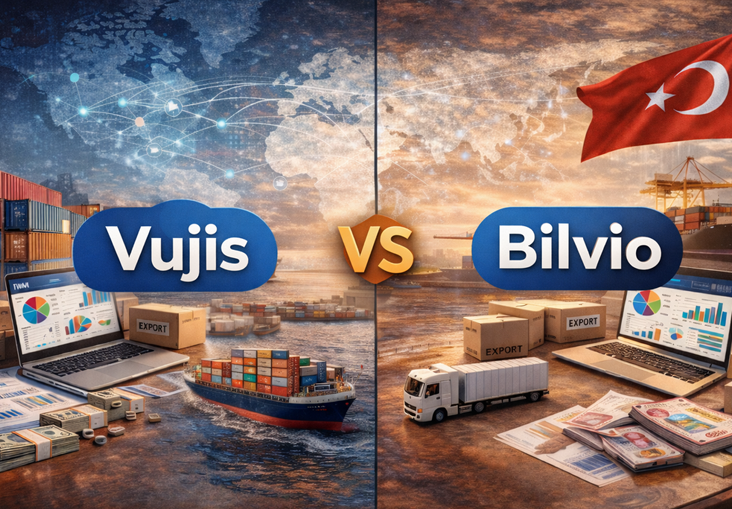
Picking a trade-data platform is not a software decision. It is a strategic choice that shows up later in sales performance, market-entry speed, and gross margin. Two platforms come up most often when an exporter is hunting for customers, reading a target market, or watching the competitive set: Vujis and Bilvio. They take different approaches, and the difference is operational, not cosmetic. The decision has direct revenue consequences.
This article puts the two side by side from a foreign-trade-operations perspective, against the criteria that actually matter on the desk in a working export company, and explains why Bilvio is the stronger fit for a team focused on outcomes rather than reports.
Find Export Customers,
Analyze Your Markets
Export 5.0 surfaces buyers and suppliers in your target market within seconds, tracks trade trends with current data, and routes you to the corporate contacts at importing companies. It is the working layer behind a serious export operation.
Export 5.0 system
1. Export Focus: Data, or Sales?
Vujis: Global Data
Vujis built its reputation on global trade data. The company holds large datasets covering shipments and trade flows, with strong analytical tooling layered on top, and that breadth is genuinely impressive.
The downside of that structure is the volume itself. The user ends up with a lot of raw material that takes time and trained expertise to filter, interpret, and turn into a closed sale. The platform pushes the analytical work onto the buyer.
Bilvio: Insight That Drives Sales
Bilvio takes a different angle on the same problem. The platform does not just display the records; it processes them through dozens of algorithms, so an exporter sees
In which country,
To which importer,
With which product,
With which strategy
the next move should happen, with the supporting evidence already attached.
Bilvio’s output is built around action: customer acquisition, importer behavior, target-market prioritization. The right yardstick is not how much data the platform holds, it is data that drives sales. By that measure Bilvio is the more results-oriented option, and the gap shows up in week-three pipeline numbers, not just in a feature comparison.
2. Local Fit: An Advantage for Turkey-Based Exporters
Vujis is headquartered in India and the United Kingdom. The platform is not built around local trade dynamics, HS-code patterns, or the regional structure of Turkish exports, which a Turkey-based team feels in the early weeks of use.
Bilvio is Turkey-based, developed inside a technology park. That changes a few things in practice:
As a tech-park company, all R&D is conducted inside the technology development zone, with the regulatory and incentive structure that comes with it.
Competitor analysis is calibrated to local realities, not to a generic European or U.S. market shape.
The product roadmap is built around how Turkish companies actually grow into international markets.
Local support and Turkish-language training shorten the learning curve, especially for first-time exporters.
For SMEs and for companies still building out an export operation, that fit is not a small advantage. It is the difference between a tool the team adopts and a tool that sits unused.
3. Speed and Ease of Use
Vujis offers analytical tooling, but the data volume drives the learning curve up sharply. Getting useful output requires a technical user with time on the calendar. For a team new to exporting, or to data analysis, the volume becomes a barrier rather than an asset, and adoption stalls.
Bilvio sits at the other end of the spectrum:
A simpler interface,
Faster filtering,
A working customer list,
Less technical overhead.
That structure is what lets sales teams pick up the platform and use it the same day, without a three-week onboarding cycle.
Time matters in exporting. The pace of customer acquisition feeds straight into export volume, and a slower discovery cycle hurts cash flow first. On that axis Bilvio is the more agile option.
4. Strategic Value: A Lot of Data, or the Right Data?
Platform strength is not a function of dataset size. What matters is data that has been filtered, targeted, and made commercially meaningful for a specific exporter’s product and market.
Vujis offers comprehensive global coverage.
Bilvio prioritizes the slice an exporter actually uses to win deals.
In particular:
Importer history
Buying frequency
Competing exporters in the same lane
Target-country segmentation
On those metrics Bilvio produces output a team can act on directly.
5. The Right Fit for SMEs and Mid-Market Companies
Most companies exporting from Turkey are SMEs. For that audience the priorities are simple:
A clean customer list, not a tangle of data
Action now, not a long analysis cycle
A sales opportunity, not a technical report
are what counts on a daily basis.
Bilvio is built around exactly that. For small and mid-market exporters it is the more accessible and operationally efficient platform, with a faster path from sign-up to first qualified lead.
End-to-End Export. Bilvio is built end-to-end. Market research, customer discovery, customer analysis, and the contact lookup at the target company all sit in the same CRM. The team is not stitching trade data, market analysis, and outreach across three different tools. Everything runs from one source, and reporting up to management is one screen instead of three.
6. Which Platform Fits an Exporter Better?
The picture lands like this:
Vujis: more global trade-data analysis
Bilvio: direct export-customer acquisition and market strategy
That is the line that separates the two platforms, and for an exporter focused on real revenue the line points one way.