The Short Answer: Why Static Importer Lists Fail to Generate Purchase Orders
No, traditional purchased importer lists rarely work for generating sustainable export sales. In B2B cross-border trade, static directories, scraped spreadsheets, and commercial databases typically produce low conversion rates, bounce rates exceeding 25%, and frequent spam-filter penalties.
Static lists treat international procurement as a phonebook directory problem. Real-world international trade is an operational logistics flow. A purchased database tells you that a corporate entity with an import license existed at some point in time; it cannot tell you whether that company imported your specific Harmonized System (HS) code last month, whether its warehouse capacity is saturated, or whether it recently dropped an incumbent supplier due to pricing friction.
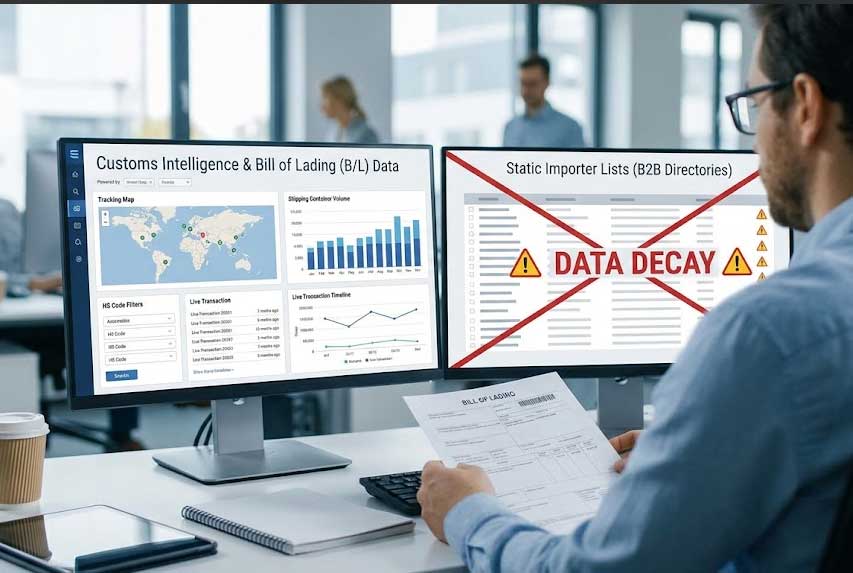
For modern exporters, foreign trade intermediaries, and sales directors, relying on purchased contact spreadsheets introduces hidden operational liabilities: domain blacklisting, wasted sales development representative (SDR) labor, and missed market opportunities. To build a predictable export sales pipeline, commercial teams are replacing speculative directories with dynamic customs intelligence—auditing verified Bill of Lading (B/L) manifests, monitoring transactional shipment frequencies, and enriching real supply chain data with direct executive procurement contacts.
Find Export Customers with AI
Analyze billions of trade data points in seconds to identify the global markets and potential customers that are right for you. Grow your export business with AI.

The Economics of Data Decay: Why B2B Trade Directories Rot
Every compiled B2B list begins decaying the moment it is exported. While consumer contact databases experience relatively gradual turnover, international trade contact data erodes at an estimated rate of 30% to 40% annually.
Three structural dynamics drive this rapid erosion:
Procurement Turnover: Purchasing managers, sourcing directors, and category buyers at mid-to-large import houses change roles or employers every 18 to 24 months. By the time a data vendor scrapes, packages, and sells a directory, key procurement personnel have moved on.
Product Sourcing Pivots: Tariff adjustments, volatile ocean freight rates, and currency swings force importers to re-engineer their supply chains continuously. A company that imported ceramic tiles from Southern Europe in 2024 may source exclusively from domestic distributors or alternative building suppliers by 2026.
Corporate Attrition and Mergers: Thousands of registered import entities quietly go dormant, merge, or change tax configurations each year. Automated web scrapers keep these inactive legal entities listed as “active buyers” indefinitely.
The 5 Structural Flaws of Purchased Importer Databases
Beyond rapid data decay, pre-packaged importer databases suffer from systemic architectural defects that undermine outbound business development campaigns:
1. The Freight Forwarder and NVOCC Trap
Automated web scrapers indexing public trade portals cannot distinguish between a Consignee (the beneficial cargo owner purchasing the goods) and an NVOCC (Non-Vessel Operating Common Carrier), freight forwarder, or customs clearing broker. As a result, commercial directories routinely list logistics providers like Kuehne+Nagel, Expeditors, or local port drayage agents as the “top importers” of industrial machinery, olive oil, or consumer electronics. Outbound sales teams end up pitching manufacturing contracts to logistics dispatchers who have zero procurement authority.
2. The “info@” Wall and Gatekeeper Blocking
Directory vendors inflate contact counts by populating spreadsheets with generic corporate addresses (info@, sales@, contact@, office@). In enterprise procurement, these mailboxes are monitored by administrative gatekeepers or filtered by automated screening algorithms. Pitching specialized industrial equipment or container-load commodities to an administrative inbox yields response rates below 0.5%. Without identifying the Category Sourcing Manager or VP of Supply Chain, cold outreach stalls at the perimeter.
3. Market Over-Saturation (The Tragedy of the Common Spreadsheet)
Commercial data brokers sell the same compiled lists to hundreds of competing manufacturers globally. A $500 spreadsheet of “Active US Medical Device Importers” has likely been purchased by competitors across Asia, Europe, and Latin America. By the time your sales representative reaches out, that buyer’s inbox has already received dozens of near-identical cold pitches. In response, enterprise buyers configure domain-level security filters to quarantine inbound emails containing typical trade inquiry templates.
4. Zero Real-Time Procurement Signals
Static directories provide binary information: a company exists, or it does not. They offer zero insight into procurement timing:
Is the company importing right now?
Did it receive four ocean containers last week, or has its import volume been zero for the past nine months?
Are its current overseas contracts locked for the fiscal year, or is it actively vetting alternative suppliers?
Without transactional volume visibility, sales reps spend equal time pursuing large active buyers and dormant legal shells.
5. Absence of Granular HS Code Alignment
Static directories categorize companies using broad, ambiguous tags such as “Automotive Parts” or “Construction Materials.” Global trade runs on 6-digit Harmonized System (HS) codes. A buyer importing precision CNC-machined transmission gears operates under an entirely different procurement and technical specification framework than one importing stamped sheet metal brackets. Generic directory categories lead to mismatched outreach and immediate disqualification.
Static Directories vs. Live Customs Intelligence
The shift toward modern foreign trade intelligence stems from a fundamental distinction: moving away from self-reported claims and toward legally audited customs manifests and shipping declarations.
The Hidden Operational Costs of Buying Cheap Buyer Lists
Purchasing a generic contact list is often treated as an inexpensive test: “If a $1,000 spreadsheet yields just one container order, it covers its cost.”
This rationale overlooks the substantial operational friction and technical damage poor data inflicts on an enterprise:
Corporate Domain Blacklisting: Enterprise email gateways (Google Workspace, Microsoft 365, Proofpoint) enforce strict deliverability controls. Maintaining a spam complaint rate above 0.3% or experiencing hard bounce rates higher than 5% triggers domain-level sending restrictions. Uploading an unvetted spreadsheet containing abandoned inboxes and spam traps can land your primary corporate domain on global DNSBL lists (such as Spamhaus or Barracuda). Once blacklisted, even critical day-to-day messages to existing clients, logistics partners, and banking institutions face quarantine.
SDR Labor Waste: When a sales representative spends 80 hours calling defunct telephone numbers, verifying departed contacts, and emailing invalid addresses, that labor represents wasted capital. Those hours are permanently diverted from researching and pitching verified, high-volume buyers.
Opportunity Cost: While your team wades through inaccurate directory data, foreign competitors leveraging transaction data identify active buyers the moment their shipment volumes shift, securing long-term supply agreements first.
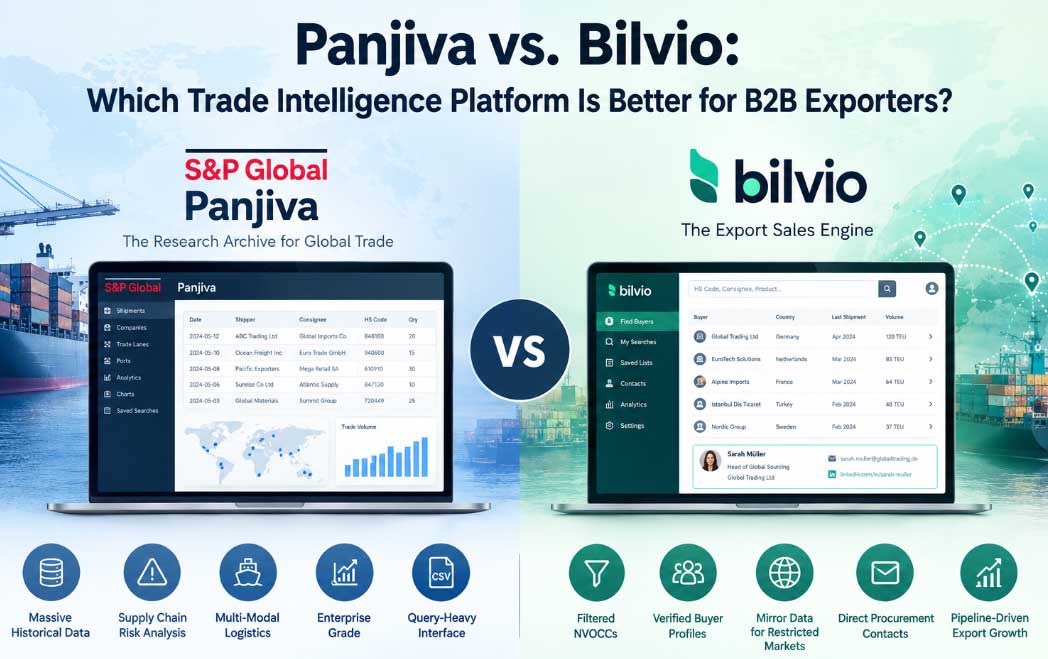
To protect sending infrastructure and focus sales resources effectively, modern cross-border teams rely on operational shipment records and customs data to engage businesses with active logistics footprints. Utilizing customizable B2B global data like Bilvio can help to prevent these expensive blind outreach missteps by focusing purely on verified logistics activity.
A 4-Step Methodology: How High-Performing Exporters Identify Active Buyers
Leading international sales organizations avoid speculative outbound messaging. Instead, they qualify prospective buyers through a 4-step data-driven funnel:
[ Step 1: HS Code Mapping ]      ---> Filter by exact 6-digit tariff code and cargo manifests
[ Step 2: Cadence & Volume ]     ---> Filter out one-off buyers; track monthly container flow
[ Step 3: Consignee Auditing ]   ---> Remove forwarders, carriers, and financial intermediaries
[ Step 4: Decision-Maker Match ] ---> Connect shipment data directly to procurement leadership
6-Digit HS Code and Cargo Description Alignment: Outbound targeting must start with your product’s international 6-digit Harmonized System (HS) code. Because customs agencies append national statistical suffixes (such as 10-digit HTS in the US, 8-digit CN in the EU, or 12-digit GTIP in Turkey), starting at the 6-digit level captures all relevant cross-border cargo manifests across target jurisdictions.
Shipment Cadence and Volume Consistency: Analyze prospective consignees based on historical frequency and container volume. Prioritize companies importing multiple Full Container Loads (FCL) on a consistent schedule over one-off purchasers who booked a trial shipment two years ago. This operational vetting relies on proven bill of lading database methodologies to inspect maritime manifests directly.
Consignee vs. Transport Intermediary Filtering: Cargo records must be audited to isolate the beneficial cargo owner. Identify whether an entity is the true commercial Consignee or merely an NVOCC, freight forwarder, or clearing agent. In transactions backed by Letters of Credit, financial institutions often appear as the Consignee, while the true commercial buyer is designated as the Notify Party.
Connecting Shipment Footprints to Procurement Decision-Makers: Once shipment intelligence confirms that a company regularly imports your product category, your sales team can target the specific executives running that procurement pipeline:
VP of Global Sourcing / Head of International Procurement
Supply Chain & Logistics Director
Senior Category Buyer (Raw Materials / Specific Product Division)
Managing Director (for mid-sized specialized distributors)
This is where a dedicated intelligence platform such as Bilvio provides immense value, allowing teams to filter out noise, map the exact import history of prospective companies, and tie cargo records back to decision-maker contact details.
Targeted cold outreach that references documented trade flows, specific port-of-entry logistics, and product specifications delivers significantly higher engagement than an unsegmented email blast sent to a general inbox.
Navigating Privacy-Restricted Markets: The Mirror Data Technique
A common operational challenge in trade analysis is that certain lucrative import destinations do not publish detailed public import manifests:
“While the United States, Latin America (e.g., Mexico, Colombia, Peru), and parts of South Asia publish detailed Bill of Lading records, customs authorities across the European Union, the United Kingdom, and Turkey maintain strict statutory confidentiality over inbound commercial consignee identities. How can an exporter verify buyers in these opaque markets without falling back on static lists?”
The solution is Mirror Trade Data Analysis (partner-country trade reconstruction).
While European customs authorities do not release public manifest dockets showing who clears cargo at the ports of Rotterdam, Antwerp, or Hamburg, exporting countries frequently treat outbound shipping manifests as public records.
By analyzing export records filed in transparent jurisdictions (such as the United States, India, or Vietnam) for shipments destined for Germany, France, or Italy, trade analysts can reconstruct the procurement networks of European importers. This reveals:
The exact corporate name and address of the European consignee taking delivery.
The incumbent overseas factory manufacturing the goods.
The frequency, transit ports, and cargo volumes involved.
Integrating mirror data into the four layers of foreign trade intelligence—macro market prioritization, operational container monitoring, competitor supply chain auditing, and targeted buyer enrichment—enables exporters to penetrate privacy-restricted markets using verified empirical evidence. Advanced intelligence providers like Bilvio use these cross-jurisdictional mirror data sets, solving the gap for harder-to-reach markets without relying on guessing or unverified spreadsheets.
The Buyer-Verification Scorecard
Before allocating capital to any prospective buyer list, directory provider, or outbound campaign, evaluate your proposed data source against this 5-point benchmark:
Frequently Asked Questions
Why do purchased importer lists have such high email bounce rates?
B2B procurement roles experience an annual turnover rate of 30% to 40%. When an employee departs or an enterprise updates its domain, old corporate addresses are decommissioned. Static databases do not update these changes in real time. Sending outreach to unverified spreadsheets triggers high bounce volumes, damaging your sending reputation and leading to domain blacklisting.
Is it illegal to purchase or use an international importer directory?
Purchasing a commercial directory is generally legal, but using it to send unsolicited marketing emails is strictly governed by privacy and communications legislation, such as the European Union’s GDPR or the UK Data Protection Act. Mass-emailing individuals without documented consent or a verifiable “legitimate interest” risks formal regulatory penalties and account suspension by email infrastructure providers.
How do I verify whether an overseas company is actively importing right now?
The only reliable verification method is reviewing Bill of Lading and customs manifest data. Tracking physical cross-border shipping activity confirms whether a company has cleared shipments over the past 30, 60, or 90 days, which ports it utilizes, and whether its overall import volume is trending upward or downward.
What is the difference between a Consignee and a Notify Party in trade data?
On a maritime Bill of Lading, the Consignee is the entity legally entitled to take delivery of the cargo at destination. The Notify Party is the entity to be alerted once the vessel docks. In Letter of Credit transactions, banks frequently appear as the Consignee to secure financial collateral, while the actual commercial buyer is designated as the Notify Party. Confusing these two roles can lead sales representatives to pitch manufacturing contracts to commercial lending banks.
Moving from Speculative Lists to Verifiable Procurement Demand
While pre-packaged importer lists are often marketed as an easy shortcut to export growth, they introduce substantial technical risks and operational inefficiencies. Predictable international business development relies on empirical logistics data: monitoring physical container movements, analyzing customs declarations, and identifying companies with active purchasing cycles.
To build an effective export pipeline, start by identifying your product’s 6-digit HS code, auditing active container volumes in target destination ports, and focusing your outbound efforts directly on verified commercial buyers. For those looking to optimize this process, trying out verified, live shipment tracking tools like Bilvio can offer a natural, resource-saving transition from spreadsheet-buying to target-focused, data-driven buyer engagement.