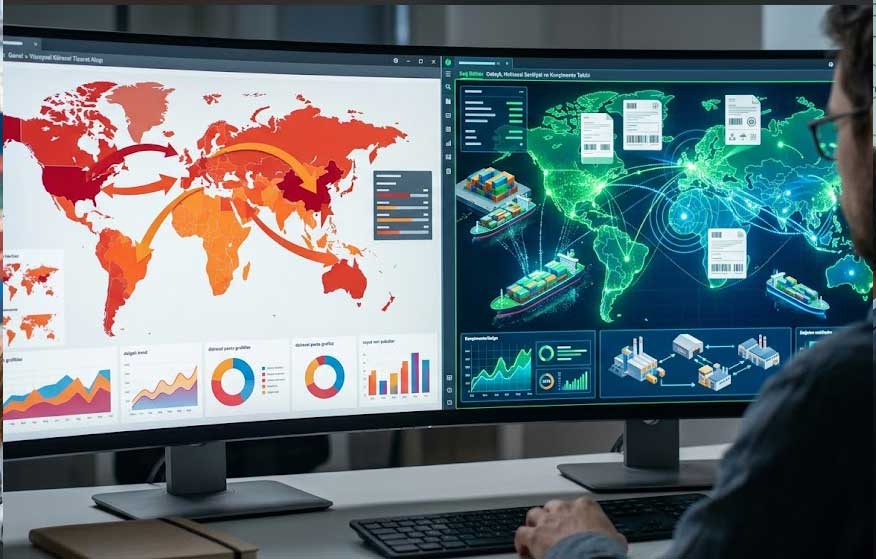

In Export, Knowledge Beats Luck
The most common mistake among companies starting or scaling export operations is this:
“My product is good. There must be buyers for it.”
Yes, the product is usually fine.
But without the right market, the right timing, and the right customers, exporting becomes a cost center.
This is where commercial intelligence in exports earns its place.
I have been running international trade and export projects for more than 10 years. With certainty I can say:
👉 A well-executed market intelligence process raises the probability of export success by at least 5x.
In this guide we cover:
- What is commercial intelligence?
- How is it applied to exports?
- What data gets analyzed?
- Where do mistakes happen?
- How do professionals work?
Everything below is laid out clearly, simply, and in a way you can put to work tomorrow.
Find Export Customers,
Analyze Your Markets
Export 5.0 surfaces real importers and suppliers in your target market in seconds, reads current trade flows, and routes you to the corporate contacts that matter. It is the operating layer for exporters who work from data instead of chasing leads.
Export 5.0 system
What Is Commercial Intelligence? (Short Version)
Commercial intelligence is a systematic process of gathering and analyzing information so a company can make data-driven export decisions.
It is not just “choosing a country.” It answers questions like these:
- Which country has demand?
- Who is importing?
- Who are the competitors?
- What is the price band?
- Which buyers actually purchase?
Featured-snippet short answer:
Commercial intelligence in exports is the analysis of data on target markets, buyers, competitors, and prices to build the right export strategy.
Why Market Intelligence Is Critical for Export
Plainly: starting to export
without market research is like setting sail without a compass.
Key benefits:
- You stop sending offers into the void
- You stop investing in the wrong country
- You can identify the real buyer
- Your bargaining power goes up
- Your sales cycle gets shorter
How to Conduct Market Research for Export (Step by Step)
Start with Product-Based Analysis
This is where the first mistake gets made. You start with
the product, not the country.
Ask yourself:
- Which countries import this product?
- Are there alternative products competing with it?
- Are there technical regulations to clear?
Tip:
The same product does not perform equally in every country.
Selecting the Target Market (Let the Numbers Decide)
Decide on the data, not on instinct.
What to analyze:
- Import volume
- Trend over the last 3 to 5 years
- Local production capacity
- Customs duties
- Logistics costs
Never Send a Quote Without Competitor Analysis
Professional exporters get to know their competition first.
What to track:
- Rival countries
- Average prices
- Packaging and certification
- Delivery methods
Without this analysis, your quotes are either too high or a loss.
Finding the Right Buyer (The Most Critical Step)
This is where time and money get burned.
Because:
- Not every company is a buyer
- Not every email gets a reply
- Not every reply turns into a purchase
A solid intelligence analysis identifies:
- Active importers
- Companies buying on a regular cadence
- Companies whose decision-makers are reachable
At this point, professional platforms make a real difference.
👉 That is why many exporters use www.bilvio.com/ihracat as a reference
during the customer-acquisition and market-analysis stages.
The platform delivers analyzed intelligence, not just raw data.
Common Mistakes in Commercial Intelligence
🚫 Searching for companies only on Google
🚫 Walking into trade shows
unprepared 🚫 Sending the same email to
every country 🚫 Quoting prices without
knowing the competition’s 🚫 Operating on the assumption that “someone is bound to buy”
Remember:
👉 In exports, the wrong target market kills even the right product.
What a Professional Intelligence Process Looks Like
| Stage | What Gets Done |
|---|---|
| Product analysis | HS code, alternative products, regulations |
| Market selection | Import data, trends, competition |
| Competitor analysis | Price, country, delivery method |
| Customer acquisition | Active importers, purchase history |
| Action | Personalized offer |
Why Bilvio Stands Out for Commercial Intelligence
Data is everywhere.
But data is not intelligence.
What sets Bilvio apart:
- Interpreted analysis instead of raw data
- Filtering from an exporter’s perspective
- Faster customer identification
- Proven market strategies
That is why many companies use www.bilvio.com/ihracat for market and customer
analysis before their first export or before entering a new market.
Frequently Asked Questions (FAQ)
Can you export without commercial intelligence?
You can. It is not sustainable. The cost of trial-and-error usually runs high.
Is it necessary for small businesses?
Especially for small businesses, it is essential. They cannot afford to make mistakes.
How long until you see results?
Done correctly, a clear list of target markets and customers can be ready in 2 to 6 weeks.
Is this only for large companies?
No. Today, even small and mid-market companies can run professional intelligence using digital tools.
Which is more important: finding customers or market analysis?
If you skip either, you get nowhere.