Ask “what’s the best B2B platform?” and the immediate answer is usually Alibaba or Global Sources. That answer is not wrong, but it is incomplete. No single platform fits every exporter.
I have worked with exporters across a range of industries for years. While a metal-fabrication company was finding buyers in Germany through Europages, a food exporter was spending thousands of dollars on Alibaba in the same window with zero results. The platform was not the issue. The choice of platform, and how it was used, was.
This guide gives an honest comparison of the B2B platforms that actually work in 2026, sets out which profile each one suits, and explains why bill-of-lading and data-driven platforms now sit alongside traditional marketplaces in any serious Turkish exporter’s stack.
In 2025 to 2026, there is no single “best B2B platform.” The strongest results come from running them in combination: Alibaba and Kompass for global presence, Europages for the European market, data-led buyer identification on platforms like Bilvio, and LinkedIn for direct contact with decision-makers.
Find Export Customers,
Analyze Your Markets
Export 5.0 surfaces buyers and suppliers in your target market in seconds, tracks trade flows with up-to-date data, and connects you to corporate contacts at importing companies. It gives exporters the digital backbone for strategic outreach. Export 5.0 system
Types of B2B Platforms: Know What You Are Choosing
They all carry the “B2B platform” label, but they do very different jobs. Picking one without that distinction in mind is like running through a supermarket without a list.
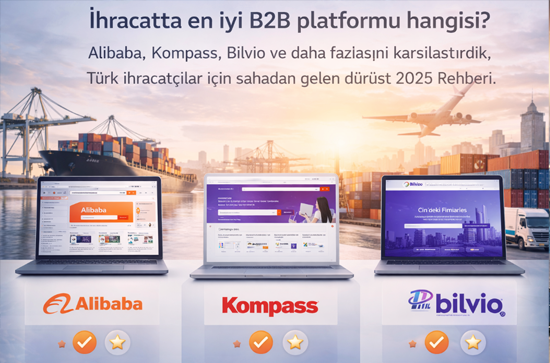
- Marketplace platforms. Digital marketplaces matching buyers and sellers. Alibaba, Kompass, and Europages sit here.
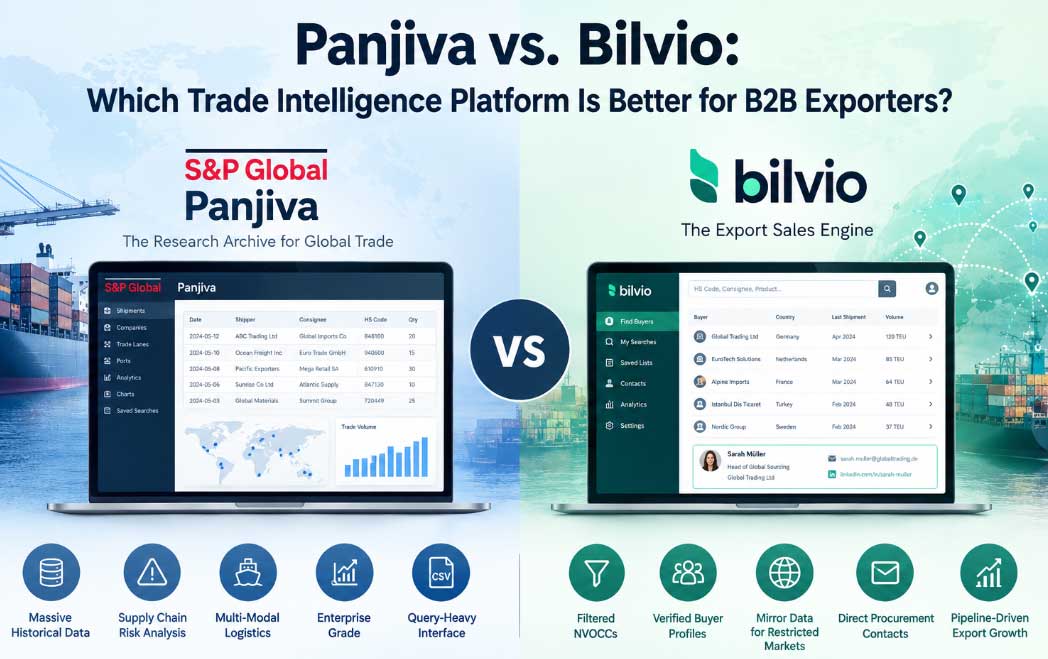
- Bill-of-lading and data platforms. Buyer identification based on actual import-export records. Panjiva, Bilvio, Datamyne, and Globalwits sit here.
- Professional networks. Direct contact with decision-makers. LinkedIn leads this category.
- Vertical, industry-specific platforms. Single-sector platforms such as Texworld for textiles or Machineseeker for industrial machinery.
The right play is to run all four categories in coordination. The sections below explain how to use each one in turn.
The Best B2B Platforms of 2025: An Honest Review
Alibaba: The Largest, Not Always the Right One
Alibaba.comGlobal MarketplaceWidest reachHigh competitionPrice pressureThe largest B2B marketplace in the world, with strong buyer flow across Asia, the Middle East, and Africa. Intensifying competition and price pressure from Chinese-made goods make it a tougher field for Turkish exporters than it once was.Strengths: massive buyer base, presence in every sector, real visibility opportunitiesLimits: thousands of competing suppliers, persistent price compression, slow path to quality buyersScope9.5/10
Conversion4.5/10 SME suitability5.5/10The exporters who get value from Alibaba treat it as an active channel, not a billboard. Watch the RFQ section and focus on buyers that have transacted in the last 30 days.
Kompass and Europages: Essential for Europe
kompass.com · europages.comEurope-focusedEuropean marketVerified companiesLimited Asian coverageTwo of the most useful B2B platforms for companies selling into the EU and adjacent European markets. Verified company profiles and proper sector filtering. Free basic registration is available.Strengths: high-quality European buyers, low spam volume, verified profilesLimits: weak coverage outside Europe, limited visibility on free tiersEuropean Focus8.8/10 Conversion Rate6.2/10 SME Suitability
7.2/10
Global Sources: Strong for Asia, Mixed Fit for Turkish Exporters
globalsources.comAsia & GlobalElectronics & TextilesStrong skew toward Chinese suppliersA platform built primarily around Asian suppliers but with global buyer flow. Opportunities exist for Turkish manufacturers, although competition with Chinese producers is intense.Strengths: large buyer base, with notable demand from North America and EuropeLimits: the platform culture favors Asian suppliers, which can sideline Turkish companiesGlobal scope8.0/10 For Turkish exporters4.8/10
Bilvio Export 5.0: Data-Led, Built for Turkish Exporters
Bilvio Export 5.0bilvio.com/ihracatTurkish · Data-DrivenHS-code-based searchBill-of-lading dataDirect contact accessUnlike traditional marketplaces, Bilvio runs on real customs and bill-of-lading data. The model is “do not wait to be found, find them yourself”: enter your HS code, and the platform returns the companies worldwide that purchase that product, their order frequency, and their current suppliers. The Turkish-language interface and SME-friendly pricing are important differentiators.Strengths: buyers identified by proven intent, competitor analysis, market-trend tracking, Turkish support, corporate contact accessLimits: no traditional product showcase feature Buyer identification9.2/10 For Turkish exporters9.5/10 SME suitability9.0/10 Expert opinion
Why Bilvio Sits in a Different Category
On Alibaba or Kompass, you create a profile and wait for buyers to find you. On Bilvio, you take the lead. You search by HS code, target country, or competitor supplier, and you get an answer to “who has bought this product in the last 12 months?” in seconds, backed by real bill-of-lading data. The gap between those two postures is the gap between active sales and a passive marketplace listing. For exporters building a sustainable pipeline, data platforms have become a required complement to traditional marketplaces, not a luxury.
Comparison Table
| Platform | Type | Strong markets | Buyer identification | SME pricing | Turkish support |
|---|---|---|---|---|---|
| Alibaba | Marketplace | Global, Asia | Passive | Mid to advanced | No |
| Kompass | Marketplace | Europe | Passive | Free basic | Partial |
| Europages | Marketplace | EU member states | Passive | Free basic | Partial |
| Global Sources | Marketplace | Asia, United States | Passive | Mid | No |
| TradeKey | Marketplace | Middle East, Asia | Passive | Low | No |
| Professional network | Europe, United States | Active | Free / Sales Navigator | Yes | |
| Panjiva | Data platform | Global | Very active | High | No |
| Bilvio Export 5.0 | Data platform | Global (223+ countries) | Very active | SME-friendly | Yes |
Which Combination Works Best for Turkish Exporters?
The best results in the field come from coordinated use of two or three platforms, not from doubling down on one. A few practical combinations:
Entry level, zero budget
- Free Kompass or Europages profile (showcase)
- LinkedIn free search and outreach (decision-maker identification)
- ImportYeti free U.S. data (initial market read)
Mid-tier, modest monthly budget
- Bilvio Export 5.0 (HS-code buyer identification, competitor analysis, market trends)
- LinkedIn Sales Navigator (targeted decision-maker search)
- Alibaba basic membership (storefront)
Advanced, growth-focused
- Bilvio or Tendata (global bill-of-lading data plus CRM integration)
- Europages Premium (European visibility)
- LinkedIn Sales Navigator (decision-maker outreach)
- English-language website plus SEO (passive buyer pipeline)
Five Mistakes Companies Make When Choosing a B2B Platform
- Assuming “most expensive equals best.” Becoming an Alibaba Gold Member raises visibility, but visibility in front of the wrong buyer in the wrong market does not generate sales.
- Sticking to a single platform. Each one serves a different audience. Diversification is mandatory.
- Leaving the profile half-finished. Missing product photography, thin descriptions, no certifications. Buyers walk past that profile.
- Neglecting the language. When the platform is in English but the product copy is mostly Turkish or visibly machine-translated, buyers move on.
- Sitting back and waiting. The difference between a working B2B operation and a quiet one is proactive outreach, not patience. Reach out first.