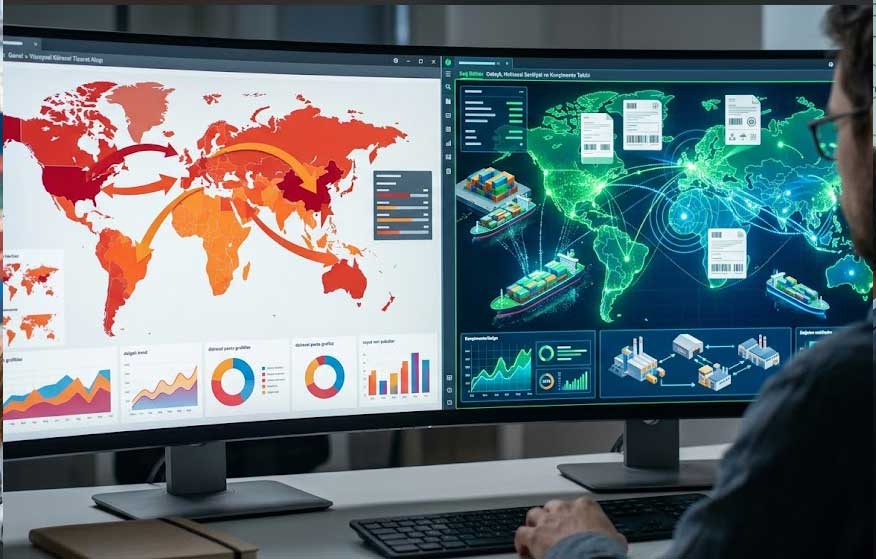
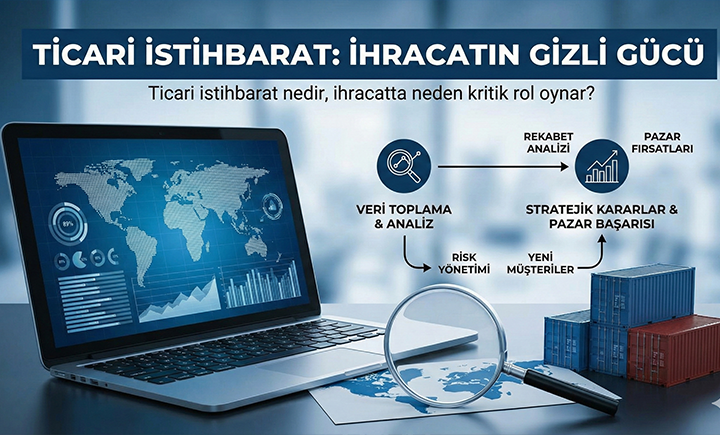
Commercial intelligence now sets one exporter apart from another more than product quality alone. The export companies winning today identify the right market, the right buyer, and the right moment through data analysis, not through volume of cold outreach. Unplanned export campaigns are giving way to disciplined, data-led approaches built on verified trade information.
This is where www.bilvio.com/ihracat
comes in. The target-market analysis, company-level intelligence reports, customs-data summaries, and risk reviews on this page give exporters concrete inputs for decision-making. Sustainable export performance comes from informed choices, not from chasing whichever opportunity surfaced this week.
Find Export Customers,
Analyze Your Markets
Export 5.0 surfaces buyers and suppliers in your target market in seconds, tracks trade flows with up-to-date data, and connects you to corporate contacts at importing companies. It gives exporters the digital backbone for strategic outreach.
Export 5.0 system
What Is Business Intelligence?
Business intelligence is the practice of collecting, analyzing, and interpreting market, customer, competitor, product, and country data for use in import and export operations. The goal is to turn raw figures into business decisions, not just charts on a dashboard.
In short, it answers the question “What should we do next?” rather than “What happened last quarter?”
Why Commercial Intelligence Is Critical in Exporting
Today’s global trade is shaped less by price and speed and more by information advantage. Two companies sell the same product. The one with better intelligence enters the market faster, sees risks earlier, and locks in customers before slower competitors finish their research.
With commercial intelligence in place, an exporter can map the following in advance:
Which countries show rising demand
Which companies are active importers
Where competitors are strong and where they are weak
Which countries face heavy price pressure
Which buyers carry payment or operational risk
All of this can be assessed before the first sales call.
The Risks of Exporting Without Market Intelligence
Exporting without proper intelligence usually produces a familiar pattern of outcomes:
The wrong destination market is chosen
Time is spent on companies with no purchasing authority
Payment and trust issues surface late
Marketing spend runs higher than it should
Sales stay short-term and rarely repeat
At that point, exporting stops being a planned growth program and becomes a reactive, uncontrolled series of campaigns.
What Market Intelligence Delivers for Exporters
Choosing the Right Market
Data-led analysis separates markets that look promising on paper from markets where buying activity is actually strong.
Reaching the Real Importer
Companies actively importing your product are identified through HS-code-level customs data, not directories.
Anticipating Risk
Country and company risk reviews reduce exposure to payment defaults and operational surprises.
Competitive Edge
Mapping competitor market share, pricing, and customer profiles produces a stronger commercial position.
Sustainable Exports
The work supports repeat, long-term buyer relationships rather than one-off shipments.
What an Effective Business Intelligence Process Includes
A useful intelligence workflow draws on:
Customs and foreign-trade statistics
HS-code-level import and export records
Company financial and risk reports
Sector and country deep dives
These sources have to be read together, not in isolation. Business intelligence is not a one-off PDF on a shelf; it is a continuously updated decision-support layer that the export team relies on month after month.