The path to exporting is no longer optional for a serious business. The global trade ecosystem is moving through one of the fastest and deepest transformations in commercial history. The trade culture that took shape over centuries along the Silk Road caravan routes shifted to ports and container ships with the Industrial Revolution; today it is being rewired through fiber-optic cables, cloud data centers, and AI algorithms. The “export route” is no longer a map between two customs points. From a 2025 vantage point, exporting has become a multi-layer game where geopolitics, financial engineering, digital reputation, and data mining all sit in the same operating model. Turkey, with its historical position between East and West and its current ambition to act as a production hub and logistics center, is offering exporters a window of opportunity that is genuinely unusual.
This report argues that exporting is not just an operational task. It shapes a company’s corporate DNA, its risk posture, and its growth ceiling. The traditional methods, collecting business cards at fairs and sending speculative emails, no longer move volume. Data-driven approaches, gathered under labels such as “Commercial Intelligence” and “Export 5.0,” now sit between a competitive operation and a slow one. Finding customers no longer looks like searching a haystack. It looks like detecting the magnetic field of the needle through the right algorithm. In that context, the technology stack at bilvio.com/ihracat is one of the strongest tools an exporter can put in front of a commercial team.
The chapters below open with macroeconomic projections for 2025, then move through Turkey’s export targets, the changing dynamics of SEO and content marketing, the current state of government incentive mechanisms, and the risk-management approach that real-world experience has shaped. The goal is a practical, measurable, sustainable roadmap for businesses across the size spectrum, from a first-time entrepreneur to a corporate group reaching for global market share. The text covers customs-regulation shifts, AI integration into search engines, logistics-cost optimization, and the cultural diplomacy that quietly decides whether a deal closes.
Find Export Customers,
Analyze Your Markets
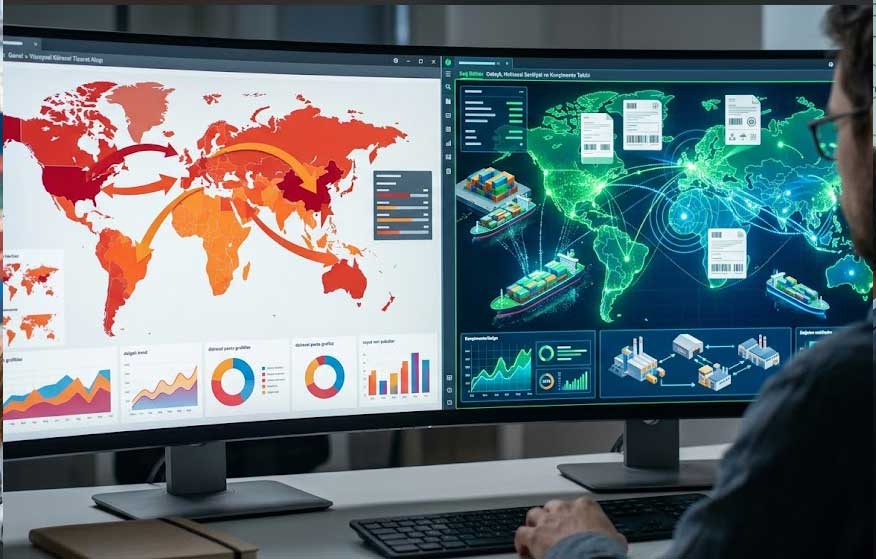
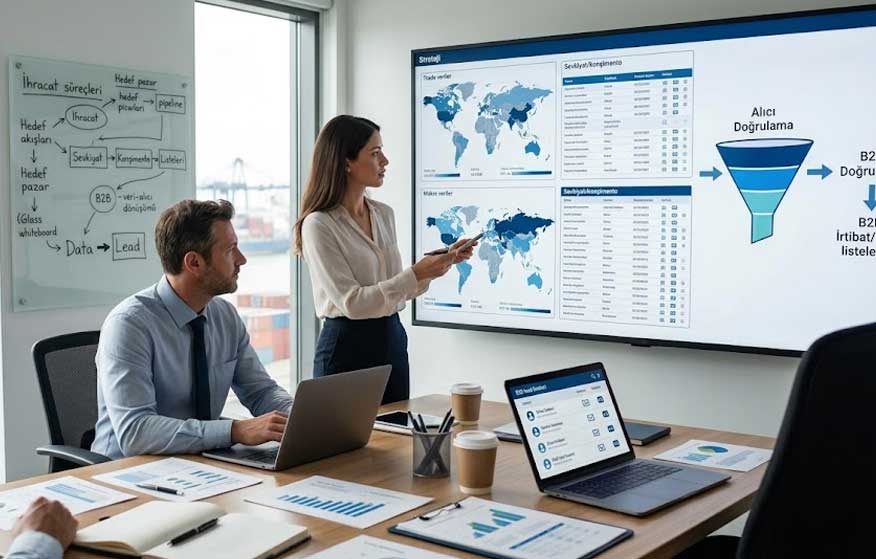
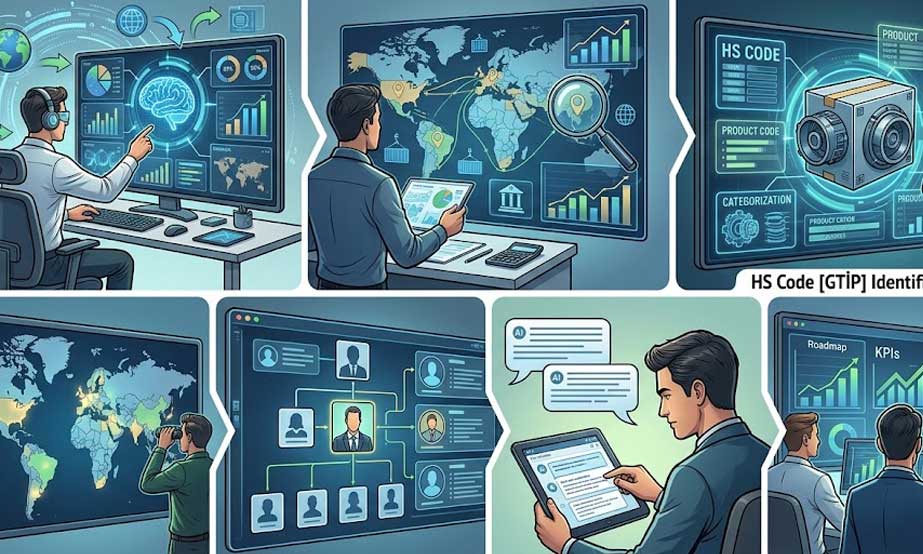
Export 5.0 surfaces buyers and suppliers in your target market within seconds, tracks trade trends with current data, and routes you to the corporate contacts at importing companies. It is the working layer behind a serious export operation.
Export 5.0 system
The global trade ecosystem is moving through one of the fastest and deepest transformations in commercial history. The trade culture that took shape over centuries along the Silk Road caravan routes shifted to ports and container ships with the Industrial Revolution; today it is being rewired through fiber-optic cables, cloud data centers, and AI algorithms. The “export route” is no longer a map between two customs points. From a 2025 vantage point, exporting has become a multi-layer game where geopolitics, financial engineering, digital reputation, and data mining all sit in the same operating model. Turkey, with its historical position between East and West and its current ambition to act as a production hub and logistics center, is offering exporters a window of opportunity that is genuinely unusual.
This report argues that exporting is not just an operational task. It shapes a company’s corporate DNA, its risk posture, and its growth ceiling. The traditional methods, collecting business cards at fairs and sending speculative emails, no longer move volume. Data-driven approaches, gathered under labels such as “Commercial Intelligence” and “Export 5.0,” now sit between a competitive operation and a slow one. Finding customers no longer looks like searching a haystack. It looks like detecting the magnetic field of the needle through the right algorithm. In that context, the technology stack at bilvio.com/ihracat is one of the strongest tools an exporter can put in front of a commercial team.
Chapter 1: Strategic Foundations and the Structural Shift in Exporting
1.1. What Exports Mean to the Economic Ecosystem
Technically, an export is the movement of goods outside the Turkish customs territory or into a free zone, in line with the applicable export and customs regulations. That definition does not capture what exports actually do for businesses or the national economy. At the macro level, exports are the strongest single driver of foreign exchange, the lever that pulls the trade deficit down, and a steady source of jobs. In a developing economy like Turkey’s, growing the export share of GDP is widely treated as a structural guarantee of economic independence and stability.
At the micro level, looking at it from inside a single business, exporting is a survival and growth strategy. When the domestic market saturates or local demand softens, an exporter holds the line by spreading risk across regions. That posture, “risk diversification,” is not just about revenue growth. Pulling cash flow into foreign currency naturally hedges the company against currency shocks. Competing internationally also forces a steady upward pressure on quality, innovation, and operational efficiency, which strengthens the company’s institutional muscles. The same upgrade then plays back into the domestic market and lifts competitive position there too.
1.2. Export Types and Operating Models
When a company designs an export strategy, the model has to fit the product portfolio, the financial position, and the target market’s structure. Turkish legislation defines several export types, each with its own operational profile and strategic use case:
General Export (Non-Special Export): The standard export regime, with no prior authorization, registration, or special procedure attached. It accounts for the largest share of Turkey’s total export volume. The process starts when the customs declaration is approved and the goods ship.
Recorded Exports: A regime for products that are tracked because of trade-policy considerations, supply security, price stability, or international agreements (certain agricultural products and scrap metals are common examples). Registration with the relevant Exporters’ Association is required before the transaction can move. Strategically, this is the lane where the state acts as a market regulator.
Credit-Based Exports: An export model where the buyer is given a defined payment term (in effect, financing). In tightly competitive markets it is used as a marketing tool to win a contract. Exchange-rate and collection risk both rise, so the deal needs the support of insurance and guarantee instruments through institutions such as Turkish Eximbank.
Consignment Export: Ownership of the goods stays with the exporter until the buyer makes a final sale. The shipment goes to a buyer, agent, or branch abroad, and the receipts come back as the goods sell. It is a useful model for entering a new market because the product gets shelf time and real demand testing before a payment cycle starts. Customs procedures are finalized as the sales settle.
Transit Trade: Goods are bought from one country and sold to a third country without entering Turkey’s customs territory or being nationalized. It uses Turkey’s logistical position to enable trade without physically handling the goods. The activity generates foreign exchange but works on a transit-trade form rather than a customs declaration.
E-Export (Micro-Export): The fastest-growing model in recent years. Through the Electronic Commerce Customs Declaration (ETGB), a company can ship up to 300 kg per shipment with a value cap of 15,000 euros under a streamlined procedure. The model opens global market access to SMEs and individual entrepreneurs while keeping logistics cost and bureaucratic load down.
1.3. Becoming an Exporter: Requirements and Legal Framework
A business that wants to export has to clear a defined set of prerequisites before the operation can start. These conditions form the spine of the state’s mechanism for recording and monitoring exports.
Tax Registration and MERSIS Registration: The exporter, as a person or as a legal entity, must be a registered taxpayer and must be registered in the Central Registry System (MERSIS).
Exporters’ Association Membership: Membership in the Exporters’ Association that covers the product’s HS code is a legal requirement. The associations log exports, compile statistics, and provide sector support. A customs declaration cannot be filed without the membership in place.
Customs Consultant Authorization: Customs procedures are technically and legally complex, so the vast majority of companies grant power of attorney to a Customs Consultant who runs the process on their behalf. The choice of consultant is a real management decision; speed and accuracy hinge on it.
Correct HS Code: The HS Code is the common product language of international trade, currently a 12-digit system in the Turkish application. Tax rates, applicable permits, available incentives, and any restrictions all flow from this code. A wrong HS Code declaration can produce serious criminal exposure, including smuggling charges. Product analysis and technical classification have to be done with full attention.
Chapter 2: The 2025 Macro View and Turkey’s Export Strategy
2.1. Shifting Balances in the Global Economy and Turkey’s Position
2025 stands out as a turning point. Global uncertainty has narrowed but the competition has become more sophisticated. The post-pandemic inflation surge has been pulled back into range by tight monetary policy at central banks worldwide, and Turkey has entered a disinflationary phase through its own stability program. As inflation comes down and the planning horizon clears, exporters can price more accurately, and investment appetite is rebuilding.
The Turkish economy is forecast to reach roughly $1.48 trillion by the end of 2025. Among OECD countries, Turkey is one of the fastest-growing, and the growth model is anchored on production and exports rather than domestic consumption. Even with European demand looking soft, Turkey’s export performance is holding up, supported by product and market diversification. The 2025 targets, $280 billion in goods exports and over $110 billion in services exports, are the clearest read on that resilience.
2.2. Sector View: Rising Stars and Open Lanes
Turkey’s export portfolio is moving away from low-value-added goods toward technology-intensive and branded products. The 2026 projections put the spotlight on the following sectors:
Defense and Aerospace: The defense industry is the country’s standout export story of the past decade and is set to remain the flagship in 2025. Global leadership in UAV/UCAV technology has opened the way for armored vehicles, naval platforms, and ammunition exports as well. The sector now has strategic depth that goes past product sales, into technology transfer and engineering services.
Automotive: The traditional export champion is adapting fast to the EV transition. As one of Europe’s largest suppliers, Turkey is targeting export levels above $35 billion by becoming a production base for electric models from domestic brands such as TOGG and from global manufacturers.
Service Exports: Often called the “smokeless industry,” service exports cover tourism, logistics, healthcare, education, and IT. Medical tourism and software exports in particular are doing real work on the current account. Service exports reached $117 billion in 2024 and are expected to keep posting double-digit growth through 2025.
Machinery and Components: The machinery sector, the backbone of industrial production, keeps gaining share, especially in European and Middle Eastern markets, on a “high quality at the right price” reputation. Turkish machinery now competes credibly with Germany and Italy at the top of the category.
2.3. The Distant Countries Strategy: Reaching for New Horizons
The Ministry of Trade’s “Distant Countries Strategy” is a deliberate move to widen Turkey’s export reach. It works as a hedge against potential softening in the EU market, where over 40% of Turkish exports currently go, and it covers 18 high-potential markets that sit further out geographically (the U.S., China, India, Brazil, and Mexico are typical examples).
For 2025, the supporting incentive structure has been put in place. Freight subsidies and overseas-warehouse rental support are pulling the heavy logistics cost of distant markets down. Promotional activity through the “Turquality” program is being prioritized to lift the visibility of Turkish products in those markets. Latin America and the Asia-Pacific region in particular look like underused lanes, with real opportunity for exporters who get there early.
Chapter 3: Digital Intelligence and the Next-Generation Way of Finding Customers
In international trade, information is the most valuable asset on the desk. Where the strongest asset used to be the personal relationships built at trade fairs, today it is the commercial intelligence sitting in databases. This phase, often called “Export 5.0,” is built on data-driven decision-making.
3.1. Where Traditional Methods Stop, and the Hybrid Model
The traditional channels for finding customers, international fairs, trade delegations, and industry magazines, are still useful, but on their own they are no longer enough.
Trade Fairs: Unmatched for reading the pulse of an industry and building face-to-face trust. The downside is real: the budget is heavy, the interaction window is short, and without disciplined post-fair follow-up the value drops fast.
Trade Delegations: The delegations organized by TIM and the Exporters’ Associations open official-channel access to a market. They are particularly effective for trust-building when entering a new country.
Commercial Attachés: The Ministry of Trade’s overseas offices provide local market intelligence and importer lists. They are also reachable online through the “Consult an Attaché” application.
The exporters who win in 2025 are running a “hybrid” model: digital intelligence tools used to identify potential customers before the fair, then targeted meetings booked during the event. That approach is what gets the most out of the fair budget.
3.2. Pinpoint Customer Identification with Bilvio
Data mining and AI have produced a new class of tooling for finding export customers. As one of Turkey’s leading platforms in this category, Bilvio answers the question every exporter eventually asks: not “Who do you know?” but “Who should you know?”
Bilvio.com and Big-Data Analytics: Bilvio processes customs records, bill-of-lading data, and commercial-registry information from across global markets, and turns that material into a usable intelligence layer. Concretely, an exporter gets:
Real Trade Data: Not surveys, not estimates. Actual import transactions. Which company bought how many tons, from which country, on which date. That tells you who the real buyer is, what their purchasing power looks like, and how steady their pattern is.
Supply-Chain Read: You can see who your target customer is currently buying from, in other words, your competitor. Tracking changes in purchase frequency tells you whether the customer is satisfied with that supplier. That read changes how you write the offer.
Search at the HS-Code Level: Instead of broad industry filters, you query down to the 12-digit HS code and find the buyers who specifically import your product. “Cotton men’s shirts” instead of “textiles.”
Competitor and Market Monitoring: The same view tracks your competitive set, not just your customers. Which markets a competitor is opening, and who they are working with, becomes input into your own strategy update.