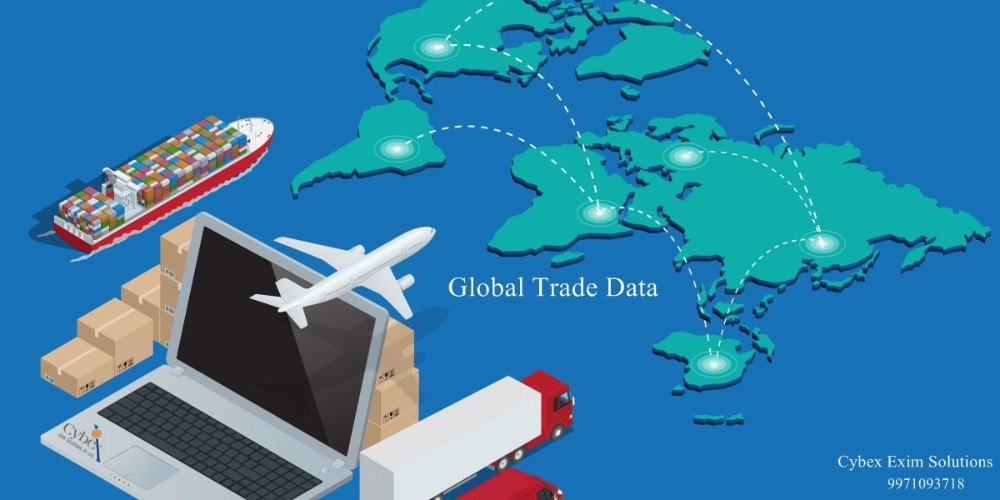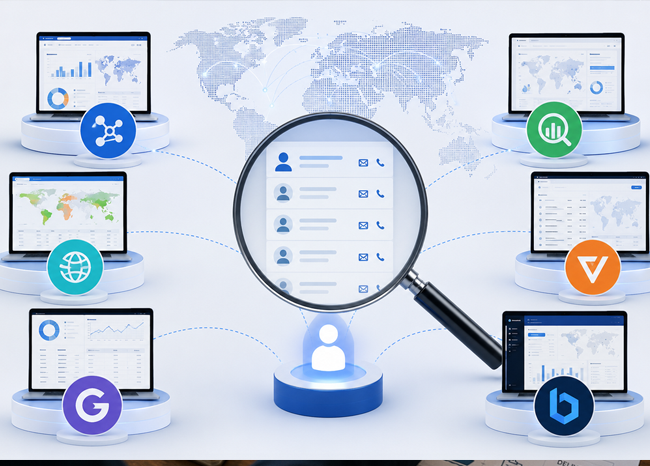

The most common version of “AI for export” being sold right now is a chatbot that drafts your cold outreach email. That is the least interesting application, and probably not the one that moves revenue. The more consequential use of machine-learning and pattern-recognition tooling in export sales is upstream: identifying which companies are actually buying your product category, in which markets, at what volumes, and from which origin countries. That is a data problem first and a sales problem second. The tools that solve it are not language models generating polished introductions. They are systems that process customs declarations, bill-of-lading records, and shipment histories at a scale no sales team can match manually.
What “AI for Export Customer Discovery” Actually Means
The phrase gets applied to at least three distinct things, and conflating them produces bad purchasing decisions.
The first is language model tooling: systems that write outreach copy, translate product descriptions, or summarize market reports. These are real productivity gains for individual contributors but do not generate leads. They make it easier to contact buyers you have already identified.
The second is pattern-recognition on trade data: systems that ingest millions of customs records, identify importers by HS code and geography, score them by purchase frequency and volume, and surface the ones most likely to be receptive to a new supplier relationship. This is where customer discovery actually happens.
The third is predictive analytics on top of trade data: using historical shipment patterns to forecast which markets are growing for a specific product category, or identifying buyers whose current primary supplier has shown declining shipment volumes (a signal of supply chain disruption and potential switching). This sits at the frontier of what commercial trade intelligence platforms offer.
For an export sales manager building a pipeline this quarter, the second category matters most. The third is worth understanding as a planning tool. The first is useful but should not be the center of an “AI strategy.”
Export 5.0 identifies buyers and suppliers in your target market within seconds, analyzes trade trends and your target markets with up-to-date data, and enables you to reach corporate contacts of companies. It offers a powerful digital infrastructure for strategic marketing.
Why Customs Data Is the Foundation
The reason customs records are worth processing at scale is that they capture behavior, not intent. A company that imported 40-foot containers of polyester fabric from Vietnam three times in the last 12 months is, by definition, an active buyer. Compare that to a contact scraped from a LinkedIn search or a trade directory listing: those sources tell you the company exists and might import something. Customs data tells you what they bought, from where, in what quantity, and when.
According to UN Comtrade, global merchandise trade covers over 200 reporting countries and involves hundreds of millions of individual transactions annually. The commercially relevant subset of that, for any given exporter, is a specific HS code in a specific set of target markets. The analytical task is filtering that universe to the 200 or 300 companies that match your product, your volume range, and your geographic priorities. That is a computation problem that requires automated processing, not a spreadsheet.
Bilvio is built specifically around this workflow. You specify your HS code and target countries, and the platform returns a list of companies that have demonstrably imported your product category, with shipment frequency, volume estimates, and in many cases the origin countries they’re currently using. That last detail matters because it tells you who you’re competing against for that buyer’s business.
[anchor text: how to read HS code import data for buyer prospecting](INTERNAL: hs-code-import-data-buyer-discovery)
The Practical Workflow: From Data to Outreach
The gap between a list of verified importers and a sales conversation involves several steps, and automating each one differently affects the quality of your pipeline.
Start with the list itself. A trade intelligence query for, say, Turkish ceramic tile (HS 6907) into Germany might return 150 active importers over the past 18 months. That is your raw universe. The first filter is volume: if you produce 20 containers a month, a company that brought in one small parcel annually is not a match. Remove them. The second filter is recency: a company whose last import was 14 months ago and showed no activity since is either out of the market or using a supplier they’re satisfied with. Deprioritize them unless you have a specific reason to target.
What remains might be 40 to 60 companies. These are worth enriching. That means finding the right contact person (typically a procurement director or import manager, not a general info@ address), verifying the company’s current trading status, and checking whether they already have relationships with Turkish exporters. If they import from Turkey already, your pitch is easier: they’ve cleared the compliance hurdle and know the logistics. If they import exclusively from China or Spain, understand why before you contact them.
The outreach itself can be drafted with language model assistance. This is where that first category of AI tooling is genuinely useful: writing a personalized first email in German, referencing their import pattern for ceramic tiles and introducing your capacity and certifications, is faster with a good language model than without one. But the quality of the outreach is limited by the quality of the underlying research. A well-written email to the wrong company wastes everyone’s time.
[anchor text: export outreach sequences that work for cold B2B buyers](INTERNAL: b2b-export-cold-outreach-methodology)
Reading Competitor Shipment Data
One application of trade intelligence that most export sales teams underuse is monitoring what competitors are shipping and to whom. If a competing ceramic tile manufacturer in Spain is supplying a German distributor you’ve been trying to reach, that shipment record is visible in the customs data (where customs records are public, which includes the US, India, and several Latin American markets).
Knowing that your competitor ships to a specific buyer tells you the buyer is active and qualified. Knowing the shipment volume tells you the scale of the relationship. Knowing the frequency tells you whether the relationship is stable or whether there are gaps. A buyer who used to receive four shipments per year from the same Spanish supplier and is now receiving two has a supply relationship that may be loosening. That is a better sales entry point than a cold approach to a company with no signals.
This kind of competitive shipment analysis is available on platforms like Bilvio for markets where customs records are accessible. The limitation is that EU import records are not publicly released at the transaction level, which means Germany, France, and the Netherlands require indirect inference rather than direct shipment data. For US, Indian, and Latin American buyers, the data is considerably more granular.
Market Selection Before Customer Selection
A mistake that often shows up in how export teams use trade data is jumping straight to company-level buyer lists without first validating that the target market is worth prioritizing. Buyer lists are only useful if the market dynamics are favorable.
Before running a buyer search, run a market-level analysis. For your HS code, look at which countries have shown consistent import volume growth over the past three years, which origin countries are gaining share versus losing it, and what the average unit value of imports suggests about the price band the market buys in. If Germany imported ceramic tile at an average CIF value of €4.20 per square meter last year (according to Eurostat Comext), and your production cost plus logistics puts you at €4.80, you have a margin problem that no amount of good outreach will solve.
ITC Trade Map is useful for this top-level market sizing. Once you’ve identified two or three markets where the import volume, growth trend, and unit value all point in the right direction, then go to buyer-level customs data to identify the specific companies to target.
[anchor text: target market selection framework for exporters](INTERNAL: export-market-selection-customs-data)
TradeGPT: Bilvio’s Export Customer Discovery Tool
Bilvio’s own implementation of this workflow is TradeGPT, a tool built specifically for export customer discovery. Rather than requiring an export team to manually filter customs databases and cross-reference company profiles, TradeGPT automates the full sequence: it searches global trade data and import records by product category or HS code, scores each potential buyer against a set of commercial criteria, and returns a ranked prospect list ready for outreach.
The scoring draws on trade history, import frequency, shipment volume, country of operation, and business profile. A company that imports your product category six times a year from three different origin countries scores differently from one that placed a single large order 18 months ago. That distinction matters for prioritization: your sales team’s time is not unlimited, and the order in which you contact buyers affects how quickly you generate meetings and orders.
Beyond the buyer list itself, TradeGPT collects and organizes contact information for each identified company, including decision-maker details where publicly available: email addresses, phone numbers, company websites, and LinkedIn profiles. This removes a time-consuming enrichment step that typically sits between “we have a prospect list” and “we have something we can actually send an email to.”
The output is a qualified lead list formatted for direct use by sales and export teams, not a data export that requires further processing before it becomes actionable. For an SME exporter without a dedicated market research function, that matters. The gap between a raw data subscription and a workable prospect list is where most smaller export teams lose time and momentum.
TradeGPT also functions as a market discovery tool in addition to a buyer finder. Running a search against a new product category or an unfamiliar geography surfaces active importers and trade flows that an exporter may not have known to look for. That makes it useful not just for executing against a known target market, but for identifying which markets to enter in the first place.
What AI Does Not Fix
This needs saying because the category is overpromised. Automated tools, including the best trade intelligence platforms, cannot resolve the problems that actually slow down export customer conversion.
They cannot tell you whether a specific buyer has a contractual exclusivity with their current supplier. They cannot predict whether the company’s procurement manager is responsive to cold outreach or routes everything through formal RFQ processes. They cannot assess the buyer’s financial health or willingness to pay on reasonable terms. And they cannot build the relationship.
What they can do is compress the research phase from weeks to hours, replace guesswork about who is buying with documented evidence, and surface competitive signals that would otherwise require an industry network built over years. For an SME exporter without a large commercial team, that compression is the real value.
The exporters who get the most out of trade intelligence tooling are the ones who combine it with disciplined outreach. They use the data to qualify and rank prospects, then apply human judgment about how to sequence the conversations, which buyers to prioritize for a trade fair meeting versus email contact, and how to position against the incumbent supplier.
Evaluating Trade Intelligence Tools
The market for export-facing trade intelligence platforms has grown considerably in the past five years. Established names include Panjiva (now part of S&P Global), ImportGenius, and ImportYeti, which are oriented primarily around US import data. Platforms like Bilvio are oriented toward exporters rather than importers, which changes the interface and the primary use case: instead of helping a US buyer verify a supplier, they help an exporter in Turkey, Vietnam, or Egypt find buyers in target markets.
When evaluating any of these platforms for export customer discovery, the questions that matter are: Which countries’ customs data does it cover, and at what level of granularity (company name, or only country-aggregate)? How current is the data (monthly updates versus real-time)? Can you filter by HS code at the 6-digit or 8-digit level? And what does the importer record actually contain: just the company name, or also shipment volume, frequency, origin country, and contact information?
Coverage and recency matter more than interface polish. A beautiful dashboard with 18-month-old data is less useful than a functional search with current shipment records.
[anchor text: comparing trade data platforms for export research](INTERNAL: trade-intelligence-platform-comparison)
Frequently Asked Questions
What does “AI” actually do when finding export customers?
In practical terms, the most useful function is automated processing of customs and bill-of-lading records to identify companies that are actively importing a specific product category. Some platforms also use pattern recognition to score prospects by purchase frequency, volume, and recency. Language models help with drafting outreach copy but do not identify buyers themselves.
Can AI tools find buyers in countries where customs data is not public?
No, and this is a real limitation. EU member state customs records are not released at the transaction level, which means buyer-level data for Germany, France, Italy, and other EU markets requires indirect methods: trade association lists, LinkedIn prospecting, or inference from non-EU data where the same buyer also imports from regions with public records. Tools that claim otherwise are either using non-customs sources or overstating coverage.
How accurate is the buyer data in trade intelligence platforms?
It depends on the source country. US import data (via the Census Bureau) is considered highly accurate and is updated regularly. Indian customs data is similarly reliable. Latin American data quality varies by country. The importer company names in bill-of-lading records are sometimes subsidiaries or customs brokers rather than the end buyer, which requires manual verification before outreach.
Is trade data tooling practical for SME exporters, or is it built for large companies?
It is practical for SMEs, and in some ways more valuable for them than for large exporters with established market networks. A large exporter has years of distributor relationships and industry contacts. An SME trying to break into a new market has none of that and relies more heavily on systematic prospect identification. A monthly subscription to a trade data platform can replace months of cold prospecting.
How should I combine trade data with LinkedIn for export prospecting?
Use trade data to identify the companies worth contacting, then use LinkedIn to find the right person at each company. Customs records give you the importer organization; LinkedIn gives you the procurement manager’s name, job title, and in some cases their professional background. The combination is stronger than either source alone.
What HS code detail level do I need for accurate buyer searches?
Six-digit HS codes are the international standard and sufficient for most market-level analysis. For buyer searches, eight or ten-digit national codes give you better product specificity, especially in categories where the 6-digit code covers a wide range of products. A ceramic tile exporter searching HS 6907 will get more relevant buyer results than searching HS 69 (ceramics broadly).
How long does it take to see pipeline results from trade-data-driven prospecting?
Faster than trade fairs, slower than you’d like. A well-organized campaign targeting 50 qualified importers identified through customs data, with personalized outreach and systematic follow-up, typically produces first meetings within four to eight weeks. First orders depend on the category: fast-moving goods with short decision cycles can close in three to four months; capital equipment or specialty chemicals with longer qualification processes may take 12 months or more from first contact to purchase order.
The practical argument for building your export customer pipeline on customs data is not that it is novel. It is that it is accurate. You are contacting companies that buy what you sell, at volumes that match your capacity, in markets where demand exists. The alternative, which is prospecting from general directories, trade fair lists, or LinkedIn searches, is a slower path to the same destination, because you spend more of your time qualifying out bad fits and less of it in actual sales conversations. Pick the method that gets you in front of the right buyer faster, and use every other tool to make that conversation better once you have it.