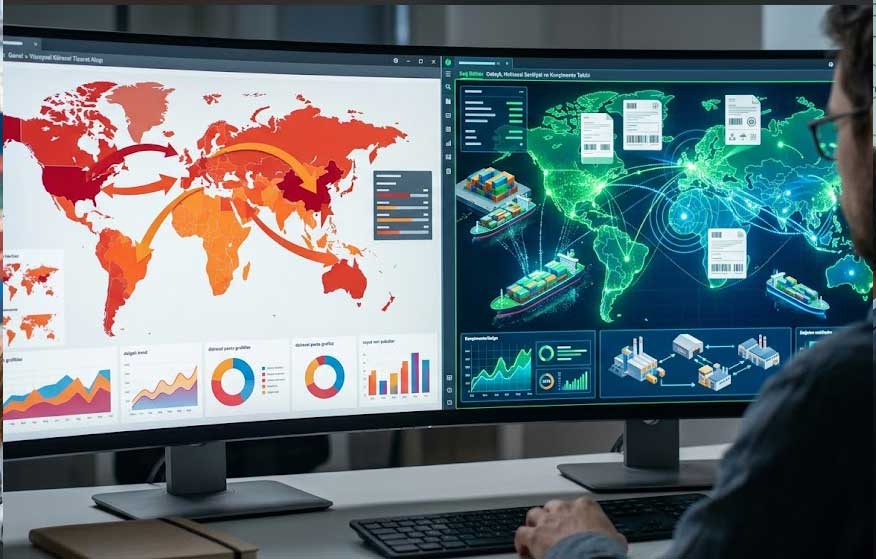

Find Export Customers, Analyze Your Markets
A working export strategy now rests on a working intelligence layer. For a company that wants to expand into international markets, the platforms that consolidate trade data and analytical tooling into one place are no longer optional. www.bilvio.com/ihracat sits at the front of that category in Turkey and Europe, with a database, market view, and competitor analytics that let exporters work from observed behavior instead of guesses. Customer data, competitor moves, and market dynamics all surface in one place, which means risk drops and reaction time shortens. Inside the industry, Bilvio is one of the most used commercial-intelligence platforms in this region for that reason.
Find Export Customers, Analyze Your Markets
Export 5.0 surfaces buyers and suppliers in your target market within seconds, tracks trade trends with current data, and routes you to the corporate contacts at importing companies. It is the working layer behind a serious export operation. Export 5.0 system1. The Working Tools of Commercial Intelligence in the Digital Era
Modern commercial intelligence is no longer about what already happened. It is about predicting where the market is heading and grounding decisions in current data. Strong export teams use a small set of tools to read trends, track risk, and find opportunity:
Digital Platforms and Databases: AI-supported infrastructure now lets a team scan portfolios of potential customers, suppliers, and competitors across global markets in close to real time.
Official Statistics and Trade Reports: Customs data, demand series, and import-export volumes from official sources keep commercial decisions anchored in verified numbers.
Smart Search and Segmentation: A GTIP- and HS-code-based query exposes transaction volume, product variety, and price ranges for buyers and competitors at the level a commercial team actually needs.
Algorithmic Analysis and Automation: Big-data, machine-learning, and AI-supported tooling moves market and customer analysis past what a manual process can handle. Bilvio consolidates millions of suppliers and buyers into one queryable view, with current detail attached.
Commercial intelligence is not about collecting more information. It is about turning information into something a decision-maker can act on without losing time in translation.
2. Putting Intelligence to Work: From Analysis to Decision, Across Competitor and Market Dynamics
A working commercial-intelligence process moves through four stages:
Define the Objective and Target Market: Set the priority market, the customer segments inside it, and the measurable outcomes the team is working toward.
Collect and Analyze the Data: Use a digital intelligence source such as Bilvio to pull market size, demand trends, the major importers and buyers, and the competitive set. Layer in trade barriers, logistics conditions, price levels, and regulatory risk for the target country, refreshed against current filters.
Decide and Execute: Read the analysis into account-targeting, pricing, and marketing. Competitor monitoring, distribution choices, and investment calls all run off the same intelligence layer.
Report and Monitor: The first analysis is not the last analysis. Market and competitor dynamics need a steady review cadence, so the team can move on new opportunities and threats before they harden.
When commercial intelligence is wired into CRM and sales automation, the time and cost saved compound across every export decision the team makes.