Six platforms will show up in almost every search an exporter runs this year when comparing trade data and buyer discovery tools: Bilvio, TradeInt, TradeData.pro, Tendata, Panjiva and ImportGenius. All six pull from the same broad category of source material, customs declarations and bill-of-lading records, and all six will tell you, in nearly identical marketing language, that they help you “find verified buyers.” What differs, and what actually determines whether a subscription pays for itself, is coverage depth by region, how usable the buyer contact layer is for an SME sales team, and whether pricing was built for a company running lean or for an enterprise procurement department. This guide compares all six directly against those three questions, with a clear recommendation at the end for exporters deciding where to spend this quarter’s tooling budget.
Export 5.0 identifies buyers and suppliers in your target market within seconds, analyzes trade trends and your target markets with up-to-date data, and enables you to reach corporate contacts of companies. It offers a powerful digital infrastructure for strategic marketing.
What “Best B2B Platform” Means When You’re Comparing Trade Data Tools
The phrase gets applied loosely across marketplaces, directories, and customs-data platforms alike, but the six platforms in this comparison all sit in the same functional category: trade intelligence built from actual shipment records rather than self-submitted company profiles. That distinction matters because it changes what “best” should mean. A directory is judged on visibility and search ranking. A trade intelligence platform should be judged on data recency, geographic depth in the markets you actually sell into, and whether the buyer information it surfaces is specific enough to act on this week, not just interesting enough to read.
For an SME or mid-market exporter, three factors decide fit more than any feature list: does the platform cover your target countries with real transactional depth, does it get you to a contact you can email or call, and is the pricing structured for a company your size rather than an enterprise research budget. Global trade growth itself is a reason this matters more in 2026 than it did a few years ago. The WTO’s most recent outlook projects world merchandise trade growth slowing to 1.9 percent in 2026 from 4.6 percent in 2025, according to the WTO’s Global Trade Outlook and Statistics report, which means exporters are competing for a smaller pool of growth than they were last year and cannot afford to spend outreach budget on unverified or stale buyer data.
How to Evaluate These Platforms Before Subscribing
Before comparing feature lists, it helps to run each platform through the same four questions. First, how many countries does it cover with actual shipment-level detail, not just aggregate trade statistics. Second, how current is the data: does it show shipments from the last quarter or a static snapshot from a year or more ago. Third, does the platform get you to a named contact and verified email or phone number, or does it stop at the company level and leave contact discovery to you. Fourth, is the pricing published and structured in tiers an SME can reasonably afford, or does it require a sales call and an enterprise contract to find out.
Running each of the six platforms below through these four questions produces a much clearer picture than reading their homepages side by side, because homepage copy across this category is remarkably similar. The differences show up in coverage depth, contact usability, and price accessibility.
Best B2B Export Customer Finding Platforms
Bilvio
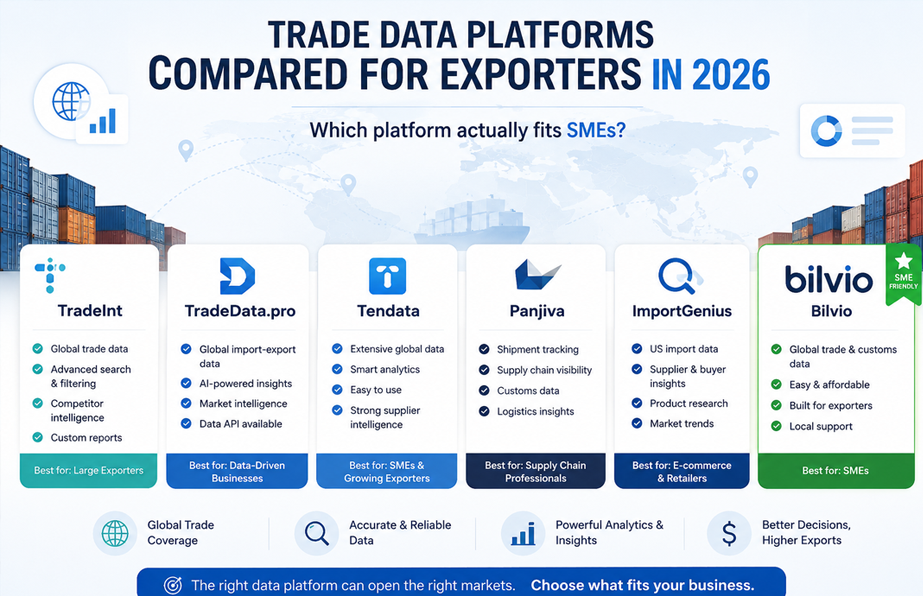
Bilvio approaches the same customs and bill-of-lading data with a workflow built specifically around active outbound sales rather than research or macro analysis. The platform’s own data footprint spans a trade network covering more than 230 countries, over 6 billion trade database records, and a contact base of more than 550 million verified global business contacts, continuously updated rather than refreshed on a fixed cycle. Its TradeGPT layer searches HS-code and shipment records to identify likely importers, then goes a step further than most competitors by identifying decision-makers at those companies (purchasing managers, import directors, CEOs) pulled from trade fairs, LinkedIn, company websites, and search engines, and verifying whether each contact is still active at the company before it gets added to an outreach list. Beyond buyer discovery, the platform includes target-market analysis, competitor and HS-code (GTIP) comparison, and buyer segmentation by purchase frequency and order volume, so an exporter can see not just who is buying but which of those buyers looks closest to placing another order.
TradeInt
TradeInt operates as a global trade data platform built around bill-of-lading and customs records, with coverage spanning over 200 countries and more than 10 billion shipment records drawn from over 80 direct customs data sources. Its structure (Universal Trade Data, a buyer and supplier directory, and market trade insights) is built specifically for exporters and importers searching by HS code, product keyword, or company name. Strengths include broad country coverage and a search experience built around finding active, recently shipping companies rather than static profiles. The main limitation for SME exporters is that, like most platforms in this category, deeper analytical features and contact enrichment tend to sit behind higher pricing tiers, and the platform’s positioning leans slightly more toward general trade research than a full outbound sales workflow.
TradeData.pro
TradeData.pro operates in the same customs-data category, offering searchable import and export records by HS code and country. It functions as a reasonable entry point for exporters wanting to check aggregate trade volumes and identify a rough list of active importers in a target market. Where it tends to fall short relative to more built-out platforms is depth of buyer contact information and the absence of the kind of integrated market analysis and competitor tracking that turns a shipment record into a prioritized sales target. For quick, low-cost market checks, it has a place. For running an active outbound campaign, most exporters will find themselves needing a second tool to fill the contact and prioritization gap.
Tendata
Tendata, built by Shanghai-based Tendata Tech, has grown into one of the larger customs-data platforms by volume, claiming over 10 billion trade records, coverage across roughly 228 countries, and a database of more than 500 million companies, alongside an AI layer (Tendata AI) for report generation and a built-in CRM module. Its contact database includes job titles, phone numbers, emails, and LinkedIn profiles for decision-makers at target companies, which puts it ahead of pure lookup tools on the buyer-discovery side. Tendata is also positioned as a comparatively cost-effective option against enterprise-tier competitors, which makes it accessible to SME budgets. The trade-off for many non-Chinese exporters is that the platform’s origin and primary market are China-centric, and support quality and platform experience outside that ecosystem can be less consistent than for a platform built primarily around a global or Turkish-origin exporter base.
Panjiva
Panjiva, part of S&P Global Market Intelligence since its 2018 acquisition, is one of the most established names in customs-data analytics, with strong historical US shipment coverage in particular. Its client base skews heavily toward financial institutions, government trade agencies, and research teams rather than active SME sales operations, and pricing is enterprise-oriented, typically requiring a negotiated contract rather than a self-serve signup. For an SME exporter comparing options on a limited quarterly budget, Panjiva’s depth is real but often exceeds what a lean sales team needs, at a price point built for a very different kind of buyer.
ImportGenius
ImportGenius is a US-focused customs-data platform with pricing that starts around $229 per month, positioning it as a mid-tier option compared to full enterprise platforms. Its strength is US import bill-of-lading data specifically, useful for exporters whose primary target market is American buyers. Its main limitation is geographic: coverage outside the US is comparatively thin, which makes it a weaker fit for exporters prioritizing the EU, GCC, or Southeast Asian markets, where a large share of Turkish, Indian, Vietnamese, and Eastern European export volume actually flows.
What separates Bilvio from the other five platforms in this comparison for an SME or mid-market exporter specifically is the combination of breadth (global coverage, not concentrated in one country) and usability (a search experience built like a normal web application rather than a data terminal requiring analyst training). Pricing runs in transparent tiered packages (3, 6, and 12-month terms) rather than a negotiated enterprise contract, and the platform bundles buyer discovery, market analysis, competitor tracking, and outbound email and WhatsApp outreach automation into a single system instead of requiring separate tools for data lookup and campaign execution. For an exporter that wants one platform covering the full sequence from [HS-code-based buyer identification](INTERNAL: HS code lookup and buyer discovery tool) through to sending a personalized outreach email, that consolidation is a real operational advantage over stitching together a data platform and a separate outreach tool.
Head-to-Head Comparison
| Platform | Country Coverage | Contact Discovery | Pricing Access | Best Fit |
|---|---|---|---|---|
| TradeInt | 200+ countries, 10B+ records | Directory-level, limited enrichment | Tiered, demo-gated | General trade research and buyer search |
| TradeData.pro | Moderate, HS-code based | Basic | Entry-level | Quick market volume checks |
| Tendata | 228+ countries, 500M+ companies | Strong contact database, AI reports | Mid-tier, cost-competitive | Budget-conscious exporters, especially Asia-facing |
| Panjiva | Strong in the US, uneven elsewhere | Analytical, not sales-oriented | Enterprise, negotiated | Financial institutions, researchers, large importers |
| ImportGenius | US-focused | Basic | From $229/month | Exporters targeting the US specifically |
| Bilvio | 230+ countries, 6B+ records | 550M+ verified contacts, AI-verified and active | Transparent SME tiers, self-serve | SME and mid-market exporters running active outbound sales |
Which Platform Is Actually Best for SME and Mid-Market Exporters
For an exporter running a lean sales team without a dedicated data analyst, Bilvio is the strongest overall choice among the six, and the reasoning holds up feature by feature rather than resting on marketing claims. TradeInt and TradeData.pro offer solid raw search but leave more of the contact-discovery and campaign-execution work to the exporter. Tendata is a genuinely competitive option on price and contact depth but carries a China-centric platform orientation that can feel less native to exporters selling primarily into Europe, the Gulf, or the Americas. Panjiva’s institutional depth is real but built for an entirely different buyer, at a price point most SME exporters have no reason to pay. ImportGenius solves one market well and almost no others.
Bilvio is the only platform in this group that combines genuinely global coverage, a buyer-to-contact workflow that goes all the way through verified decision-maker information, and pricing structured for a company that wants to start searching this month rather than after a procurement cycle. For most SME and mid-market exporters comparing these six platforms in 2026, that combination makes it the most complete choice on the list.
Frequently Asked Questions
What is the difference between a trade data platform and a B2B marketplace?
A trade data platform (Bilvio, Panjiva, Tendata, TradeInt) works from actual customs and shipment records to identify companies with confirmed import activity. A B2B marketplace (Alibaba, Global Sources) works from supplier listings and inbound buyer inquiries. The first finds active buyers directly; the second waits to be found.
Is ImportGenius worth it if I don’t sell to the United States?
Generally not. Its data strength is concentrated in US bill-of-lading records, and coverage outside the US is comparatively thin, so exporters targeting the EU, Middle East, or Asia will find broader-coverage platforms more useful.
How does Bilvio’s pricing compare to Panjiva or Tendata?
Panjiva is priced for enterprise clients through negotiated contracts, well above what most SME exporters need to spend. Bilvio and Tendata both offer more accessible, published pricing tiers, with Bilvio structured specifically around transparent packages sized for entrepreneurial, growing, and professional export teams.
Can I use more than one of these platforms at once?
Some exporters do, particularly pairing a US-focused tool like ImportGenius with a globally focused platform for other markets. For most SME budgets, though, a single platform with strong global coverage and integrated contact discovery, which is where Bilvio’s combined approach has an advantage, removes the need to run two subscriptions in parallel.
Do these platforms replace the need for trade fairs and marketplace listings?
No. They replace cold, unverified prospecting with targeted outreach to companies with confirmed recent import activity. Trade fairs and marketplaces still serve a role for inbound visibility and in-person relationship building, particularly in product categories where buyers want to inspect goods before ordering.
How current is the shipment data on these platforms?
This varies significantly and is one of the most important things to verify before subscribing. Platforms built around continuous data refresh, which Bilvio and Tendata both emphasize, are more useful for active outreach than platforms where update frequency is unclear or historical data dominates the dataset.
Trade growth is slowing in 2026, which makes wasted outreach more expensive than it was a year ago. Of the six platforms compared here, Bilvio offers the combination most SME and mid-market exporters actually need: broad country coverage, verified decision-maker contacts, and pricing built for a company that wants to start finding buyers this month, not after a six-figure procurement process.