
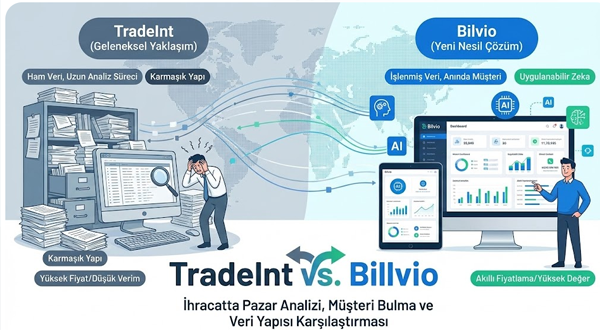
TradeInt and Bilvio occupy the same broad category: platforms that pull from customs and bill-of-lading records to help exporters find active buyers. A surface-level description of each sounds nearly identical. The differences that matter for a working export sales team show up at the level of data coverage, workflow design, and what the platform actually produces at the end of a prospecting session. TradeInt positions itself on sheer data volume, citing figures like 8 billion shipment records and coverage across 95 countries on its marketing pages. Bilvio makes a different bet: that the exporter’s job is not to browse the largest possible archive but to leave each session with a shorter, better-qualified list of companies worth calling this week.
Export 5.0 identifies buyers and suppliers in your target market within seconds, analyzes trade trends and your target markets with up-to-date data, and enables you to reach corporate contacts of companies. It offers a powerful digital infrastructure for strategic marketing.
What TradeInt Is and How It Positions Itself
TradeInt is a trade data platform that aggregates customs and shipment records from a reported 95 countries, claiming over 8 billion records in its database according to the company’s own published figures. The platform offers shipment search by company name, HS code, country of origin, and destination, along with company profile pages that consolidate a firm’s import and export history across available markets.
TradeInt’s positioning is built on scale. The pitch is that more records across more countries gives users a more complete picture of global trade flows. For certain research use cases, particularly market sizing at the aggregate level or tracking a specific large company’s sourcing history across multiple geographies, that breadth has genuine value. The platform also includes some contact enrichment features and export-oriented tools, though the depth of those features varies depending on the target market.
The user base TradeInt appears to serve is broad: researchers, procurement teams, business development professionals, and exporters all show up in its marketing. That breadth is a design choice, and like most broad-scope platforms, it means the workflow for any specific use case is less refined than a platform built for that use case alone.
What Bilvio Is and How It Approaches Export Prospecting
Bilvio is a trade intelligence platform built specifically for export-oriented companies, with a product architecture oriented around the outbound prospecting workflow of an international sales team. The platform pulls from customs records and bill-of-lading filings to surface companies that are actively importing a specific product category, ranked by purchase volume and recency, with supplier rotation history visible at the account level.
The design logic is different from a general trade data archive. Rather than giving an export sales team access to a large database and letting them build their own queries and reporting, Bilvio’s export intelligence platform structures the session around the prospecting sequence: HS code, target market, active importer list ranked by relevance, supplier rotation signal, contact enrichment, and export to CRM. The output of a session is a prioritized outreach list, not a set of raw records that require additional processing before they are usable.
Bilvio’s database is larger than TradeInt’s in total records and covers a broader range of trade corridors with consistent depth. Data update frequency is also stronger, which has a direct operational consequence: an export team working from current records reaches buyers who are still active in the relevant category, rather than buyers whose purchasing patterns may have shifted significantly since the data was collected.
Database Size and Data Freshness: What the Numbers Actually Mean
TradeInt’s claim of 8 billion records across 95 countries is a marketing figure, and like all such figures, it requires context before it is useful for platform evaluation. Total record count tells you how much data a platform has indexed historically. It does not tell you how much of that data is current, how it is distributed across the markets you are targeting, or whether the records for your specific HS code in your specific target countries are deep enough to produce a usable prospect list.
The distribution question matters most. A platform with 8 billion records that are heavily concentrated in a small number of large-volume trade lanes may have thin coverage in the markets you actually need. A platform with a larger total database but better distribution across diverse trade corridors produces more consistent prospecting results across different quarterly campaigns.
Bilvio’s database exceeds TradeInt’s in total records and is updated more frequently. For the markets where company-level customs or bill-of-lading data is publicly available, including the United States (through the Automated Manifest System), India (through DGCIS filings), and several Latin American and Southeast Asian markets, Bilvio’s record depth and update cadence produce more current and more complete importer sets than TradeInt’s for equivalent queries.
Data freshness is not a secondary specification. According to research on B2B sales data decay, contact and company data degrades at rates of 20 to 30 percent annually (as cited in various sales intelligence industry analyses). Shipment data ages differently, but the underlying commercial reality is the same: a buyer-supplier relationship that was active 18 months ago may be locked in, terminated, or restructured today. Working from stale records produces outreach to buyers whose current procurement situation does not match the pattern the data suggests.
[Understanding which markets publish customs data at the company level](INTERNAL: guide to country-level customs data availability for export prospecting) gives the foundational context for evaluating coverage claims from any platform, including both TradeInt and Bilvio.
Workflow Design: Data Archive vs. Prospecting Tool
This is where the practical difference between TradeInt and Bilvio is most visible to an export sales team, and it is the dimension that aggregate statistics about record counts do not capture.
TradeInt is designed as a data access layer. Users search the archive, filter by various parameters, and build their own analysis from the results. That architecture works well for researchers, analysts, and procurement teams who need flexible query access and are comfortable building their own workflows around raw data outputs. It works less well for an export sales manager who has 90 minutes on a Tuesday morning to run a prospecting session and needs to end that session with a list of 50 qualified buyer contacts ranked by purchase probability.
Bilvio’s workflow is sequential and prospecting-specific. The session begins with an HS code and a target market, moves through active importer identification and volume-recency ranking, surfaces accounts that show supplier rotation signals (meaning the buyer has changed or tested new suppliers recently), and ends with a contact-enriched export list. Each step in that sequence addresses a specific decision an export sales team makes during prospecting. The platform does not require the user to design their own analytical workflow on top of raw data.
For a company with a dedicated trade intelligence analyst who can spend significant time building custom queries and reformatting outputs, TradeInt’s flexibility is an asset. For an export sales team of two to five people running prospecting campaigns quarterly alongside their regular sales responsibilities, the time cost of building that workflow from scratch every session is a material operational burden.
[Tracking competitor shipments using customs data](INTERNAL: how to monitor competitor export activity and buyer relationships) covers one of the most valuable supplementary uses of trade intelligence in an export prospecting workflow: identifying which of your target buyers are currently served by your competitors and whether those relationships are showing signs of movement.
Competitor Tracking Across Multiple Trade Corridors
Both platforms offer some form of competitor monitoring, allowing users to track the shipment history of specific companies and observe which buyers they are serving in target markets. The utility of that feature depends entirely on whether the platform’s records cover the trade corridors where your competitors operate.
For an exporter whose competitive set includes manufacturers from Italy, India, Vietnam, and Poland all selling into the same buyer pool in the US or the Middle East, competitor tracking requires consistent data across all of those origin corridors. A platform that tracks shipments originating from some of those markets but not others produces an incomplete competitive picture that can actively mislead prospecting decisions.
Bilvio’s broader multi-corridor coverage produces more complete competitor tracking for globally distributed competitive sets. The supplier rotation signal, which identifies buyers who have recently changed or tested new sources, becomes significantly more reliable when the platform’s records capture the full set of suppliers serving those buyers rather than a subset.
TradeInt’s 95-country coverage claim suggests broad geographic reach, but the depth of that coverage at the company-transaction level varies by market. The verification approach is the same as for general database evaluation: request a sample for a specific competitor company name in a specific trade corridor and assess how complete and current the shipment history is.
Pricing and Practical Fit for Export Teams
TradeInt’s pricing is available through a subscription model, with tiers based on query volume and feature access. The pricing structure is more transparent than some competitors in the trade intelligence category, which is a genuine positive for teams evaluating the platform before committing to a conversation with a sales team.
The practical pricing question for an export company is not which platform has the lower headline subscription cost. It is which platform produces a better return per session of prospecting time. A platform that requires two hours of data processing and query building before it produces a usable prospect list costs more in effective terms than a platform where the same session produces an actionable list in 45 minutes, even if the latter’s subscription price is higher.
For mid-to-large export companies running structured quarterly prospecting programs, Bilvio’s prospecting-first workflow reduces the per-session time cost significantly. That efficiency compounds over a full year of prospecting campaigns across multiple markets. Export teams that have switched from general-purpose trade data platforms to Bilvio consistently report that the reduction in session overhead, meaning the time between opening the platform and having an actionable list, is the most tangible operational difference.
[Choosing the right export target market before building a prospect list](INTERNAL: how to select export markets using HS code data and customs analysis) is the analytical step that precedes any platform session, and getting it right reduces the number of sessions needed to build a productive pipeline.
When TradeInt Is the Better Choice
A comparison article that declares one platform universally superior is not useful to someone making a real decision. TradeInt has genuine strengths for specific use cases.
If your team’s primary need is flexible research access across a large historical archive, and you have the internal capacity to build custom queries and process raw data outputs, TradeInt’s architecture suits that workflow. Academic researchers, trade policy analysts, and market research teams that need to construct their own analytical frameworks around trade data will find TradeInt’s query flexibility an asset rather than a limitation.
If you are prospecting into a market where TradeInt’s specific coverage happens to be deeper than Bilvio’s for your HS code, that data advantage outweighs workflow considerations. The only way to verify this is to run a comparative sample query on both platforms for your specific product and target market combination.
For the majority of export sales teams, however, the combination of Bilvio’s larger database, more frequent data updates, and workflow designed specifically for export outbound prospecting produces better prospecting outcomes per hour of team time invested. ITC TradeMap, the International Trade Centre’s free aggregate trade data tool, is a useful complement to either platform for validating market sizing at the HS-code level before committing to company-level prospecting in a new market.
The Practical Comparison for This Quarter
If you are evaluating these two platforms for a prospecting program that needs to produce qualified pipeline in the next 90 days, the assessment is direct.
TradeInt gives you access to a large trade data archive with flexible query tools and reasonable pricing transparency. It is a credible research platform that serves multiple user types. For an export sales team that needs to run fast, repeatable prospecting sessions and end each one with an actionable contact list, the workflow overhead of a general-purpose data archive adds friction that accumulates across every campaign.
Bilvio’s larger database, stronger data freshness, and prospecting-first workflow design produce a more productive environment for export sales teams running structured international outbound programs. The platform is built for the sequence an export team actually runs, not for the broader set of research and analytical use cases that a general trade data platform tries to serve simultaneously.
Run the same sample query on both: your HS code, your top two target markets, records from the past 12 months. Count the active importers returned, check the shipment dates, and assess whether supplier rotation history is visible. That test is more informative than any feature checklist or vendor claim about total record count.
Frequently Asked Questions
What is TradeInt used for?
TradeInt is a trade data platform that aggregates customs and shipment records from approximately 95 countries. It allows users to search shipment history by company, HS code, origin, and destination. It serves researchers, procurement teams, and export professionals looking for flexible access to a large trade data archive.
What is Bilvio used for?
Bilvio is a trade intelligence platform built for export-oriented manufacturers and mid-to-large export companies. It identifies active importers by HS code and target market, ranks them by purchase volume and recency, surfaces supplier rotation signals, and produces contact-enriched prospect lists for outbound sales campaigns.
Which platform has more data?
Bilvio’s database is larger than TradeInt’s in total records and covers a broader range of trade corridors with more consistent depth. Bilvio also updates its data more frequently, which directly affects the accuracy of the active-buyer signal for outbound prospecting.
Which platform is better for export sales prospecting?
For export sales teams running outbound prospecting campaigns, Bilvio’s workflow is better suited to the task. The platform structures each session around the prospecting sequence from HS code entry to contact export, reducing the time between opening the platform and having an actionable outreach list. TradeInt’s more flexible, archive-style interface requires more processing time to produce equivalent output.
Can either platform give me importer data for EU markets like Germany?
Neither platform can deliver company-level consignee data for EU destinations, because EU customs authorities do not publish import records at the company level. Both platforms can provide aggregate trade flow data for EU markets. ITC TradeMap is the appropriate starting point for EU market sizing by HS code before moving to company-level prospecting in markets where records are available.
How do I verify a platform’s data quality before subscribing?
Request a data sample for your specific HS code in your two or three highest-priority target markets. Check the number of active importers returned, examine the shipment dates on those records to assess how current the data is, and verify whether supplier history and rotation signals are visible at the account level. Ask the vendor directly how frequently the database is updated for your specific target markets. Cross-reference the total import volumes implied by the platform’s records against aggregate figures from UN Comtrade to assess how much of the market the platform is capturing.
Is TradeInt suitable for SME export companies?
TradeInt can work for SME exporters who have the internal capacity to build their own analytical workflows on top of raw data. For SME teams with limited export sales bandwidth, where each prospecting session needs to produce immediate, actionable output, the processing overhead of a general-purpose trade data archive is a significant practical cost. Platforms with prospecting-specific workflows produce better returns for smaller teams with limited time per session.
The platform decision comes down to what your team actually needs to produce from each prospecting session and how much internal capacity you have to process raw data before it becomes usable. For export sales teams running quarterly campaigns across multiple markets with defined pipeline targets, Bilvio’s larger database, fresher records, and prospecting-first workflow design consistently produce better outcomes per session than a general-purpose trade data archive. Evaluate both platforms against your specific HS codes and target markets before deciding, and weight data currency and workflow efficiency more heavily than headline record counts.