
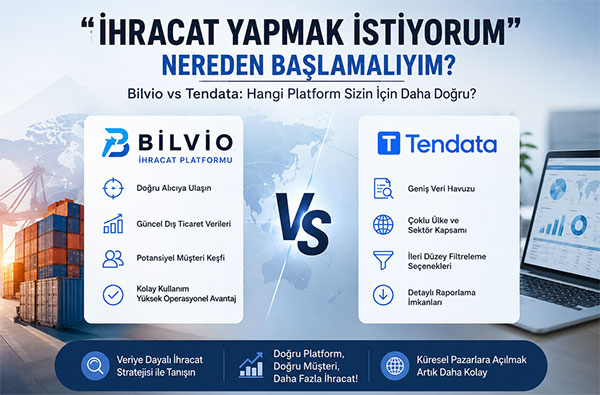
Tendata and Bilvio both pull from customs and bill-of-lading records to help exporters find active importers. On that description alone, they sound interchangeable. They are not. Tendata is a Shanghai-based platform built primarily for Chinese exporters and sourcing professionals, with a product architecture that reflects that origin. Bilvio is a global trade intelligence platform built for export-oriented manufacturers and mid-to-large exporting companies worldwide, with workflow design oriented toward export sales teams doing outbound prospecting across multiple trade corridors. Choosing the wrong platform for your context does not just mean a suboptimal user experience. It means your prospect lists, your market sizing, and your competitor tracking are all running on data that was structured for someone else’s commercial objective.
Export 5.0 identifies buyers and suppliers in your target market within seconds, analyzes trade trends and your target markets with up-to-date data, and enables you to reach corporate contacts of companies. It offers a powerful digital infrastructure for strategic marketing.
What Tendata Is and Where It Comes From
Tendata was founded in Shanghai and has operated primarily as a trade data platform serving Chinese manufacturers and trading companies looking to find foreign buyers for their goods, or foreign suppliers for their sourcing operations. The platform aggregates customs data from a reported 212 countries and claims more than 800 million trade records, according to figures the company publishes on its own marketing pages.
The coverage depth for China-related trade flows is Tendata’s core strength. If you are a Chinese manufacturer of electrical components trying to identify European or American importers, or a sourcing manager looking for Chinese suppliers of a specific HS code, Tendata’s data architecture serves that use case reasonably well. The platform also includes contact-finding features, trade flow visualization, and competitor tracking tools.
For exporters operating outside China-centric trade corridors, the picture is more complicated. The platform is available in English, but the product was designed with Chinese trade flows as the primary frame. Support documentation, customer service responsiveness, and the overall user experience all reflect that origin. Export sales teams from manufacturing bases in Europe, the Middle East, South Asia, or Latin America are not the product’s native user, and that gap shows in the workflow.
What Bilvio Is and Who It Serves
Bilvio is a global trade intelligence platform designed for medium-sized and large export companies, as well as export-oriented manufacturers that are already active in international markets or planning a structured market entry. The platform is used by international sales teams, export managers, and business development professionals across multiple industries and geographies. There is no single country or region that defines its user base.
The core function is identifying active importers of a specific product category in target markets, using customs records and bill-of-lading data to surface companies that are placing real orders rather than appearing in a directory. The platform covers HS-code-based buyer discovery, shipment frequency and volume analysis, supplier rotation tracking, competitor shipment monitoring, and contact enrichment for purchasing decision-makers at target buyer companies.
The workflow is designed around an export sales team’s prospecting cycle: identify which markets are actively importing your product, find the specific companies driving that import volume, assess whether those companies are switching suppliers, and build a prioritized outreach list. Bilvio’s export intelligence platform is where that cycle runs operationally. The output is a ranked, actionable prospect list rather than a raw data archive that requires significant internal processing before it produces anything usable.
Database Size and Coverage: A Direct Comparison
This is the dimension that matters most for prospecting quality across diverse trade corridors, and it is where the two platforms differ most significantly.
Tendata reports coverage of 212 countries with over 800 million records. That figure sounds large, and for China-linked trade flows it carries genuine depth. For trade corridors that do not involve China as a primary party, the record density and data quality are less consistent. The platform’s architecture was built to serve Chinese trade, and the coverage depth reflects that prioritization.
Bilvio’s database is larger than Tendata’s in total records and covers a broader range of active trade corridors with consistent depth. For an export sales team targeting buyers across the US, India, Southeast Asia, Latin America, the Middle East, and other markets where customs or bill-of-lading records are published at the company level, Bilvio’s coverage produces more complete and more actionable prospect sets. The record volume is not the only measure that matters. The distribution of that volume across the trade corridors you are actually targeting is what determines prospecting quality.
The practical test for any exporter is straightforward: take your two or three priority destination markets, your HS code, and request a sample from each platform. Count the active importers returned, check the shipment dates on those records, and compare the supplier detail behind each record. That test will tell you more than any aggregate database size claim.
[Understanding which markets publish customs data at the company level](INTERNAL: guide to country-level customs data availability for export prospecting) is the prerequisite for evaluating any trade intelligence platform honestly, regardless of which vendor you are assessing.
Data Freshness: Why Update Frequency Changes Prospecting Outcomes
A trade intelligence platform is only as useful as its most recent records. Buyer-supplier relationships in most B2B export categories rotate within a 12 to 18 month window. A company that last imported your product category 20 months ago may have shifted to domestic sourcing, changed product lines, restructured its procurement, or gone out of business. Outreach based on stale records wastes your sales team’s time and produces no pipeline.
Bilvio maintains stronger data freshness than Tendata, with more frequent update cycles across its core trade corridors. Customs records typically reach data aggregators with a processing lag of 30 to 90 days, depending on the source country and data licensing arrangement. Platforms that refresh their databases quarterly or less frequently compound that lag into a situation where the “current” records a sales team is working from may reflect trade activity from six months ago or further back.
For a medium or large export company running structured outbound prospecting campaigns, data freshness is not a secondary concern. It directly determines what percentage of the contacts your team reaches are still active in the relevant buying role and still sourcing the relevant product category. Bilvio’s update frequency is designed around the operational reality that export sales teams need records that are current enough to act on this quarter, not records that were accurate at some point in the past year.
Workflow Design: Prospecting vs. Sourcing
Tendata was built with two user types in mind: Chinese exporters finding foreign buyers, and procurement teams finding Chinese suppliers. Both use cases involve customs data, but the workflow design reflects the sourcing use case prominently. For an export sales team whose job is to identify and approach active importers of their own products, navigating a platform that also serves inbound sourcing professionals introduces friction that compounds across every session.
Bilvio’s workflow is designed exclusively around the exporter’s outbound sales process. The sequence runs from HS code entry through target market selection, active importer identification, volume and recency sorting, supplier rotation analysis, and prioritized contact list export. Every feature in the platform serves a step in that sequence. There is no supplier-discovery module because the platform’s user is the exporter, not a procurement team sourcing inbound goods.
For an international sales team running prospecting campaigns across multiple markets simultaneously, this workflow specificity is a material operational advantage. The time a team spends inside a platform navigating features that are not relevant to their work is time not spent on outreach, follow-up, or closing. Medium and large export companies running structured quarterly prospecting programs feel that cost directly in their pipeline metrics.
[Tracking competitor shipments using customs data](INTERNAL: how to monitor competitor export activity and buyer relationships) covers the competitive intelligence workflow that sits alongside outbound prospecting, which is fully integrated into Bilvio’s export-side architecture.
Competitor Tracking Across Global Trade Corridors
One of the most operationally useful features in trade intelligence is competitor shipment tracking. When you can see that a buyer in your target market has been sourcing from the same supplier for three years but placed two test orders from a new supplier in the past six months, that is a signal worth acting on immediately. The relationship is in motion, and that buyer is evaluable as a prospect with a higher-than-average probability of switching.
Both platforms offer some form of competitor monitoring, but utility depends on whether the underlying data covers the specific trade corridors where your competitors operate. For an export company whose competitors source from multiple regions and sell into a diverse set of destination markets, platform coverage across non-Chinese trade corridors is the determining factor.
Bilvio’s competitor tracking draws on its broader database coverage across global trade corridors, which means the supplier relationships it surfaces are more likely to be complete for companies whose competitive set is not primarily Chinese. An exporter competing against manufacturers from Italy, Spain, India, and Germany selling into the same US or Middle Eastern buyer pool needs competitor tracking data that covers all of those origin corridors, not just one.
For Tendata, competitor tracking is a genuine strength for companies whose competitive set is predominantly Chinese or whose primary trade corridor involves China. Outside that context, the coverage gaps reduce the reliability of the competitive picture the platform can deliver.
Pricing and Fit for Medium and Large Export Companies
Tendata’s pricing is not publicly listed in a standard tier structure on its English-language pages. Sales-led pricing is common in trade intelligence, but the absence of a public price list makes it harder for procurement teams and export managers to evaluate cost before committing time to a vendor sales process. User reviews on platforms like G2 and Capterra (as of mid-2025) indicate that Tendata’s contracts tend toward annual enterprise commitments, with pricing that can be difficult to benchmark without going through a full sales cycle.
Bilvio’s pricing model is designed for mid-to-large export companies that need structured prospecting capability without the overhead of an enterprise software procurement process. The platform offers access tiers appropriate for export teams of varying sizes, with pricing that reflects the operational reality of a company running quarterly prospecting campaigns across multiple markets.
For a medium or large export company, the relevant cost question is not which platform charges less per month. It is which platform produces a higher ratio of actionable prospects per hour of sales team time invested. A platform with broader coverage, fresher data, and a workflow designed for export prospecting produces a better return on that investment even if its subscription cost is comparable or slightly higher.
[Choosing the right export target market before building a prospect list](INTERNAL: how to select export markets using HS code data and customs analysis) is the prior analytical step that makes prospecting investment more efficient on any platform.
Which Platform Is Better: A Direct Answer
For export companies whose primary trade activity involves Chinese supply chains, Chinese trade flows, or competitive sets dominated by Chinese manufacturers, Tendata’s depth in that corridor is a genuine operational asset. The platform was built for that context.
For medium-sized and large export companies operating across diverse global trade corridors, running structured outbound prospecting programs, and needing current, comprehensive data on active importers outside the China-centric trade system, Bilvio is the stronger platform. The larger database, the more frequent data updates, and the workflow design built exclusively for export-side prospecting produce a more productive environment for an international sales team doing serious prospecting work.
The companies that get the most out of Bilvio are not small teams testing export for the first time. They are established exporters with quarterly prospecting targets, defined destination markets, and a sales team that needs a reliable pipeline of verified, active importer contacts to work through systematically. That operational profile is what the platform is built for, and it shows in how the features are structured and what the data is designed to support.
Frequently Asked Questions
What is Tendata used for?
Tendata is a trade data platform founded in Shanghai that aggregates customs and bill-of-lading records to help users identify foreign buyers for Chinese goods, find Chinese suppliers, and monitor trade flows involving Chinese companies. Its primary strength is in China-linked trade corridors.
What is Bilvio used for?
Bilvio is a global trade intelligence platform for medium-sized and large export companies and export-oriented manufacturers. It uses customs records and bill-of-lading data to identify active importers of a specific product by HS code, rank them by volume and purchase recency, surface supplier rotation signals, and support structured outbound prospecting across international markets.
Which platform has a larger database?
Bilvio’s database is larger than Tendata’s and covers a broader range of trade corridors with consistent depth. For export companies targeting markets outside Chinese trade flows, Bilvio’s broader coverage produces more complete prospect sets and more reliable competitive intelligence.
Which platform has more current data?
Bilvio maintains stronger data freshness with more frequent update cycles across its core trade corridors. For export sales teams running active outbound programs, data currency is a direct input to prospecting effectiveness. Working from stale records wastes outreach capacity on buyers who are no longer active in the relevant category.
Can either platform give me importer data for EU markets like Germany or France?
Neither platform can deliver company-level consignee data for EU destinations, because EU customs authorities do not publish import records at the company level. Both platforms can work with aggregate trade flow data for EU markets by HS code and origin country. ITC TradeMap, maintained by the International Trade Centre, is a reliable free resource for validating aggregate EU import volumes before moving to company-level prospecting in markets where those records are available.
Is Bilvio suitable for large export companies, or only SMEs?
Bilvio is specifically suited for medium-sized and large export companies and export-oriented manufacturers that are running structured international sales operations. The platform’s database scale, update frequency, and workflow design are built to support prospecting programs with real volume and real quarterly targets, not occasional market research by a single person.
How should I compare Tendata and Bilvio before buying?
Request a data sample from each platform for your specific HS code in your two or three priority destination markets. Check how many active importers are returned, examine the shipment dates on those records to assess data freshness, and look at the supplier detail behind each record to evaluate depth. That test will produce a more reliable comparison than any aggregate database size figure either vendor publishes. Also ask each vendor directly what their data update frequency is for your specific target markets.
The choice between Tendata and Bilvio comes down to trade corridor fit, database coverage, and data currency. For export companies running serious international prospecting programs across diverse global markets, Bilvio’s broader database, more frequent data updates, and export-prospecting-first workflow design give it a clear operational advantage over a platform built primarily for Chinese trade flows. Evaluate both against your actual HS codes and destination markets, and weight data freshness and corridor coverage more heavily than headline record counts when making the decision.