
Most export teams still run their pipeline off a spreadsheet, a customs broker’s phone number, and whichever trade show badge scanner promised the most leads last year. That is not a criticism, it is how the industry grew up. But the gap between an exporter using an ERP plus a CRM and one that has added trade intelligence (customs and bill-of-lading data tied to live buyer discovery, the way platforms like Bilvio’s export intelligence tools at bilvio.com/en/ structure it) is now the difference between chasing leads and picking them off a list of companies that are already importing your product category. This article compares the technology categories an export company actually needs, in the order they earn their cost, and where each one starts to show diminishing returns.
What counts as “useful technology” for an export company
Export operations touch five distinct jobs: finding buyers, qualifying them, closing and documenting the deal, moving the goods, and getting paid. A tool is useful to the extent it removes friction or reveals information at one of those five points. That sounds obvious, but it is where most software evaluations go wrong: teams buy a tool because a competitor has it, not because it fixes a step where they are actually losing time or losing deals.
The categories worth comparing are ERP and order management, CRM tuned for export sales cycles, trade intelligence and customs-data platforms, market research and target-market analysis tools, logistics and freight visibility platforms, trade finance and documentation software, and digital marketing or lead generation tools built for B2B export. Each solves a different one of the five jobs above. None of them substitutes for another, which is the first mistake buyers make: assuming a strong CRM reduces the need for buyer discovery data, or that a logistics dashboard tells you anything about market demand.
ERP and order management: necessary, not a differentiator
An ERP system (SAP Business One, Odoo, Microsoft Dynamics, or a regional equivalent) is table stakes once an export company passes roughly 15 to 20 active SKUs or more than a handful of recurring buyers. It keeps inventory, production, invoicing, and shipping documentation in one system instead of three disconnected ones. For a company still tracking purchase orders in Excel, ERP is the single highest-leverage purchase available, full stop.
Where exporters overspend is treating ERP as a growth tool. It is not. ERP manages the business you already have; it does not find the business you do not have yet. Companies that expect an ERP rollout to increase sales are consistently disappointed, because that was never the tool’s job. Budget for ERP as operational infrastructure, and budget separately, deliberately, for the tools that actually generate new buyers.
CRM built for export sales cycles
A generic CRM (HubSpot, Pipedrive, Zoho) works fine for export sales as long as the team customizes the pipeline stages to match how export deals actually move: initial inquiry, sample request, price negotiation against a specific Incoterm (commonly FOB or CIF for ocean freight), credit or LC terms discussion, first order, and then the far more important stage most CRMs ignore entirely: repeat-order cadence. Export B2B relationships live or die on whether the second and third orders happen, and most off-the-shelf CRM templates are built for domestic sales cycles that close once and move on.
The practical fix is not a specialized export CRM (few exist and most are overpriced for what they do); it is customizing a standard CRM’s fields to capture buyer country, applicable HS code, typical order volume, and reorder interval. [Setting up a CRM pipeline for export sales](INTERNAL: crm-pipeline-export-sales-guide) is worth doing properly once, because a badly configured CRM produces worse decisions than no CRM at all, since it gives false confidence in data nobody actually trusts.
Trade intelligence platforms: the category most exporters are still missing
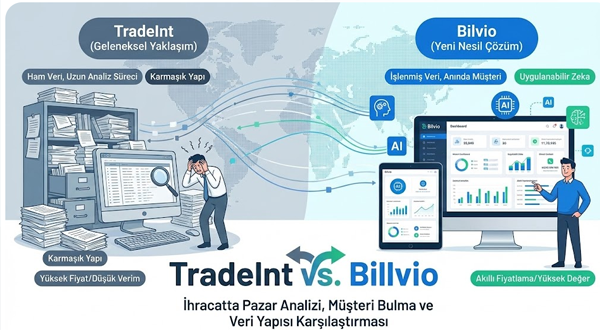
This is the category that changes how the first four jobs (finding, qualifying, closing, and repeat-selling) actually work, and it is the one most SME exporters have not adopted yet. Trade intelligence platforms pull from customs declarations and bill-of-lading records, which in most countries are public or semi-public shipping data, and turn them into a searchable database of who is actually importing a given HS code, from which countries, at what volume, and how often.
The practical difference this makes: instead of cold-emailing a list built from a trade directory or a LinkedIn search (where you cannot tell if a company imports anything at all), an exporter can pull every company that received a shipment under HS code 6109 (T-shirts, knitted) into the US in the last six months, filter by volume and by which supplier country they are currently sourcing from, and prioritize the accounts already buying at scale from a competitor. This is the specific job Bilvio’s platform is built around at bilvio.com/tr/ihracat: turning customs and bill-of-lading records into a buyer list an outreach team can actually work, rather than a document a compliance officer would need a week to parse. The same underlying data also supports [competitor shipment tracking](INTERNAL: competitor-shipment-tracking-guide), since a competitor’s own bill-of-lading trail shows exactly which buyers they are shipping to and at what frequency.
The honest limitation: customs data quality and availability vary by country. US import records are detailed and public through the Automated Manifest System. Many European countries restrict bill-of-lading data more tightly, and some emerging markets have thin or delayed reporting. An exporter targeting the US, Mexico, or several Latin American markets will get rich data; one targeting Germany or France directly will need to lean more on market research and distributor intelligence alongside customs records, not instead of them.
Market research and target-market analysis tools
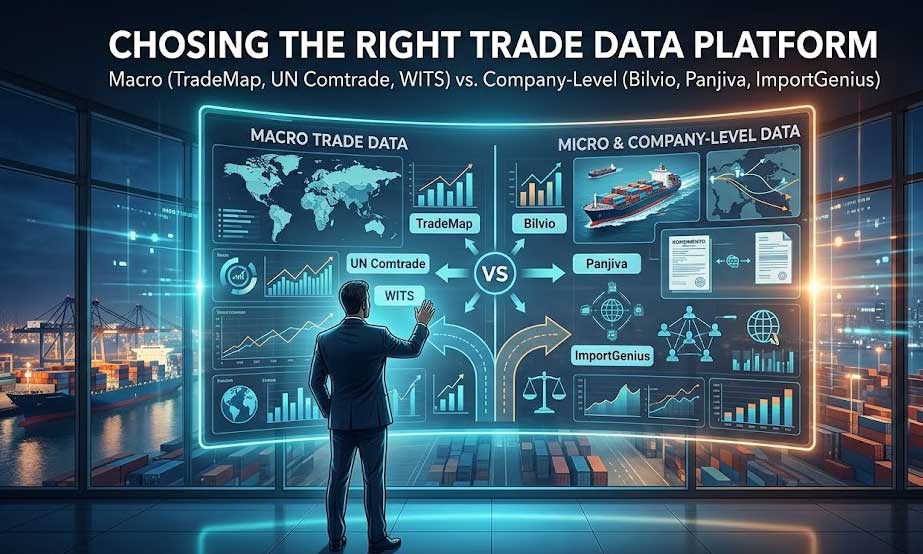
Before an exporter runs buyer discovery on a specific HS code and country pair, they need to know that pair is worth pursuing. Market analysis tools, whether that is UN Comtrade’s own database, ITC Trade Map, or the target-market analysis modules built into a trade intelligence platform, answer a narrower but critical question: is import demand for this product category in this country growing, flat, or declining, and who currently supplies it.
This step gets skipped constantly because it feels slower than jumping straight to outreach. It is not optional. An exporter who spends three weeks building a buyer list for a market where import volume dropped 12% year over year (a number to pull from Comtrade or a national statistics office before committing, not assumed) has wasted the three weeks regardless of how good the outreach list is. [Reading a target market before building an outreach list](INTERNAL: target-market-analysis-for-exporters) should happen before, not after, buyer discovery.
Logistics and freight visibility platforms
Freight visibility tools (Flexport’s tracking layer, Project44, or a freight forwarder’s own portal) solve a different problem entirely: once goods are moving, where are they, and will they clear customs on schedule. These matter enormously for operational reliability and customer trust, particularly for exporters selling on tighter delivery windows into retail or manufacturing supply chains. They do nothing for finding new buyers, and conflating “we have good shipment tracking” with “we have good market intelligence” is a common and costly confusion in how export teams describe their own tech stack to management.
For most SME exporters, a freight forwarder’s existing visibility tools are sufficient until shipment volume or SKU complexity grows enough to justify a dedicated platform. This is usually the last category worth paying for separately, not the first.
Trade finance and documentation tools
Letters of credit, export credit insurance platforms (Atradius, Euler Hermes, or a national ECA like Turk Eximbank), and digital documentation tools for certificates of origin and packing lists round out the stack. These reduce risk and administrative time but, like ERP, they do not generate demand. They matter most once deal volume is high enough that manual LC review or documentation prep becomes a bottleneck, typically somewhere north of 20 to 30 shipments a month for a lean back-office team.
Digital marketing and lead generation tools
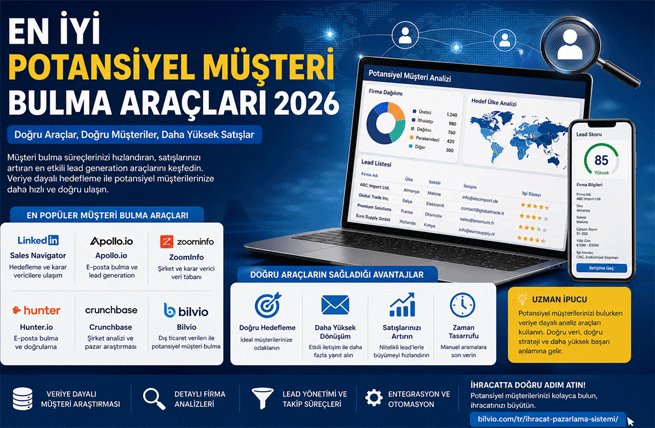
B2B export marketing technology (LinkedIn Sales Navigator, industry-specific directories, trade show lead capture tools, and outbound email platforms) generates awareness and inbound interest but does not verify that a prospect actually imports the product category in question. This is the structural weakness of marketing-first lead generation for export: a well-targeted LinkedIn campaign can reach the right job titles at the wrong companies, because job title and actual import activity are not the same signal.
The strongest setups combine the two: use trade intelligence data to build the target list of companies with confirmed import activity in the relevant HS code, then use marketing and outbound tools to reach the right contact inside those specific companies. Marketing tools without customs-verified targeting produce more activity; customs-verified targeting without marketing execution produces a list nobody calls. Both halves are needed, and most export teams currently only have the second half built out.
How to sequence the purchases
For an SME exporter building a tech stack from close to zero, the order that earns back its cost fastest is: ERP first if order volume already exceeds manual tracking capacity, then trade intelligence and market analysis together (since one without the other produces either unqualified prospects or a validated market with no list to work), then CRM configured properly around the export sales cycle, then marketing and outbound tools layered on top of a customs-verified target list, and trade finance or dedicated logistics platforms last, once volume justifies the added cost. Buying in reverse order, which is common (marketing tools first, trade intelligence last, if ever) is the single most avoidable reason export sales teams spend a year generating activity without generating qualified pipeline.
Frequently Asked Questions
What is the most important technology for a small export company to buy first?
If order volume already exceeds what a spreadsheet can track reliably, ERP comes first. If the bigger problem is finding buyers, trade intelligence and market analysis tools should come before CRM or marketing software, since they determine who is worth pursuing in the first place.
Is trade intelligence software worth it for a company exporting under $2 million a year?
Yes, for most product categories, because the cost of building an unqualified prospect list manually (broker fees, trade show travel, weeks of cold outreach) usually exceeds a mid-tier trade intelligence subscription, and the resulting list is verified against actual import activity rather than guesswork.
Can customs data really show who is importing a specific product?
In countries with public import manifests, including the United States and several Latin American markets, yes: records typically include the importer name, product description, HS code, volume, and country of origin. Coverage and detail are thinner in parts of Europe and some emerging markets, so results vary by target country.
Do I need a specialized export CRM, or does a standard CRM work?
A standard CRM works fine once its pipeline stages and fields are customized to reflect export-specific data: Incoterm, HS code, order volume, and reorder cadence. Few dedicated export CRMs justify their added cost over a well-configured standard tool.
How do trade intelligence tools and market research tools differ?
Market research (trade statistics, Comtrade-style data) tells you whether demand for a product category is growing in a given country. Trade intelligence, built on customs and bill-of-lading records, tells you which specific companies are importing it right now, which is the buyer list market research alone cannot produce.
Should logistics and freight tracking software be an early purchase?
Usually not the first purchase. It solves shipment visibility after a sale closes, which matters for operational reliability but not for generating new business. Most SME exporters can rely on their freight forwarder’s existing tools until shipment complexity grows.
What is the biggest mistake exporters make when building a technology stack?
Buying marketing and lead generation tools before trade intelligence and market analysis tools. It produces high activity against a list that was never verified as containing companies that actually import the product, which wastes both the outreach budget and the sales team’s time.
The technology stack that actually moves an export business is not the most expensive one, it is the one sequenced against the five real jobs: finding buyers, qualifying them, closing, shipping, and getting paid. Start with whichever job is currently the bottleneck, usually buyer discovery for most SME exporters, and build outward from there rather than assembling tools by category checklist.